Yitzhak Rabin: “I know the Syrians. If they say they will do something, that means they will do the opposite.”
Luvrani: “The Americans are preoccupied with other problems, so direct channels between Lebanon and Israel must be opened.”

In his meeting with Israeli politician Yitzhak Rabin on August 1, 1983, several months after the signing of the May 17, 1983 Agreement, Pierre Gemayel, leader of the Kataeb Party, revealed the ideological and political basis of his positions, which, according to Abdel Halim Khaddam, were “completely contrary to Lebanon’s interests, particularly those of the Christians.”
Khaddam adds that “during this meeting, Rabin pointed to pressure within Israel calling for the withdrawal of its army from Lebanon, and asked whether the Lebanese Army could fill the vacuum resulting from such a withdrawal. Sheikh Pierre then delivered a lengthy speech thanking Israel for its assistance, which had saved Lebanon’s Christians. He summarized the history of the Christians in Lebanon and the stages they had gone through in building a state with a secular system in which they coexisted with Muslims, and said that he wanted this system to return.
He noted that when his son Amin spoke, he spoke on behalf of both Muslims and Christians, and that thanks to the very policy Israel criticized, Amin had succeeded in reaching the agreement with Israel. Gemayel said that the Christians had fought the Palestinians for eight years on behalf of the Israelis, and again thanked Israel for its assistance at a time when others had not dared to act. He remarked that it was unfair not to give the Israelis their due, since they alone had shown the courage to act.
He stressed the existence of friendship between the two countries and the establishment of a triangle involving the United States. He asked his interlocutor to work toward an alliance between Lebanon’s Christians and Druze, since both were minorities among Muslims. He considered that Lebanon could play the role of mediator between Israel and the Arab world, emphasizing that Israel’s greatest gain would be the signing of the agreement, which represented all of Lebanon.
He then criticized the Syrian regime, describing it as a backward Arab regime, while Lebanon represented European civilization, and said that America should not lose hope, so that the Russians would not be able to take control of the entire Arab world.”
Rabin replied: “The Americans lost a major opportunity when they were not allowed to remove the Syrians from Lebanon at the beginning of 1983.”
Uri Lubrani, an Israeli diplomat, considered that America was preoccupied with other problems. They wanted to support the Gemayel government and remove the Syrians, but were distracted by other issues around the world. Therefore, direct channels between Lebanon and Israel should be opened. He considered that the president’s failure to sign the agreement was being used by the Syrians as a pretext to criticize the Israeli presence in Lebanon.
Gemayel concluded that there was an agreement with the Americans for the complete withdrawal of the Israeli army from Lebanon, and that this could be used as leverage against the Syrians.
The verbatim text of the meeting between Pierre Gemayel and Yitzhak Rabin
The meeting took place on August 1, 1983, at Sheikh Pierre Gemayel’s office at the Kataeb Central Headquarters. Present on the Lebanese side were Sheikh Pierre Gemayel, Fadi Afram, Tony Braidy, Naoum Farah, and Woody. On the Israeli side were Yitzhak Rabin, Uri Lubrani, and Amnon.
Rabin: I want to thank you for this meeting, and, although belatedly, I would like to offer my condolences for Bashir. We all knew him from the beginning of our relationship. When we first met in 1976, the situation was difficult, and I believe that establishing the relationship was the best thing that happened, especially because I remember what you told me. The decision was difficult for him, as he was waiting for a change in Israeli policy. From that point onward, the relationship was not at its best, but there was a change, and there is now a good opportunity for Lebanon to remain Lebanese.
Sheikh Pierre told me in 1976, “I want to live in Lebanon with my head held high as a Christian.” I believe that under the current circumstances, which require decisive decisions, I am not in government now and can therefore express my opinion freely.
The question in Israel is not what happened, but what will happen. The question being asked by the public is: How long are we going to remain in Lebanon? You want all foreign forces to withdraw from Lebanon. I know that the fundamental question is whether the Syrians will accept this or not. But Israel will reach a point where it will redeploy or begin withdrawing, and the question is: Can the Lebanese Forces and the Lebanese Army fill the vacuum resulting from this?
Redeployment is inevitable. Whatever the means, it will ultimately happen. The question is whether you are prepared for it.
In 1976, we told you that we would help you help yourselves. We cannot fight on your behalf, but Israel will help those who want Lebanon to be sovereign and free. Today the situation is the same, and Israel is ready to help, but Israel cannot do everything by itself.
I am pleased to meet you again because I have good memories of our first meeting. I have always regarded you as a patriot, and we will deal with each other as one patriot to another. I told you that our history is like yours: the Jew waited for hundreds of years to return to his homeland. Wherever they lived, they considered themselves strangers and wanted to return to their homeland. Their faith was extraordinary, and after two thousand years they succeeded in returning to their land.
Pierre Gemayel: I will continue speaking on the national level and leave the political level for later. After 440 years of struggle, we have preserved this mountain, while the entire surrounding region was Sunni, and everything that was not Sunni was considered inferior. We Christians were considered fifth-class. We succeeded in turning it into a country of freedom, which is why we have 17 sects, all of which feel that they are in their own country.
We were always afraid of any Syrian or Arab union because it was an Islamic union. We succeeded in persuading the French to guarantee Lebanon’s independence within its 10,000 square kilometers—a country where all civilizations meet. Lebanon is the only country among the Arab states where all sects are respected and where there is no state religion.
Returning to the political level: the existence of Israel and the existence of Lebanon must continue. We must understand each other, you and us. At first this was unclear, but after contact was established between us, you understood and realized that it was in your interest to help us preserve our freedom and dignity.
For eight years, we took your place and fought the Palestinians who wanted to drive us from our land. Here I want to thank you for what you did and because you saved us. During those eight years, Lebanon became the center of global terrorism, and the whole world became afraid. No one looked toward us because they were happy to keep the “microbe” here rather than let it reach them.
Lebanon became a danger to the world, America, and France, and the entire world did not want to touch the problem until Israel came and did what it did to save us and rid Lebanon of all this. Without you, I do not see how we would have been able to free ourselves, because Europe, America, and the Arabs were afraid. You alone did it, and you had the courage.
Now Israel is here forever, and so are we. Lebanon needs a friend to remain standing—and I mean a friend in depth, not a superficial friend. Of course, I am not asking you to die for us, nor us to die for you, but to understand us and for us to understand you. Perhaps others do not understand us.
We need you, and you need us. We are trying to make America, Israel, and Lebanon friends together. We chose America because we are not communists; we belong to the American ideological camp—we are on the right, not the left. We found that it was in our interest to be with America rather than the Russians. We saw that there was complete agreement between Israel and America, and therefore we developed our relationship with both America and Israel.
Today we emphasize our relationship with America just as we do with Israel. After eight years, we acknowledge that Israel is the one that saved us, and we cannot do anything other than recognize that.
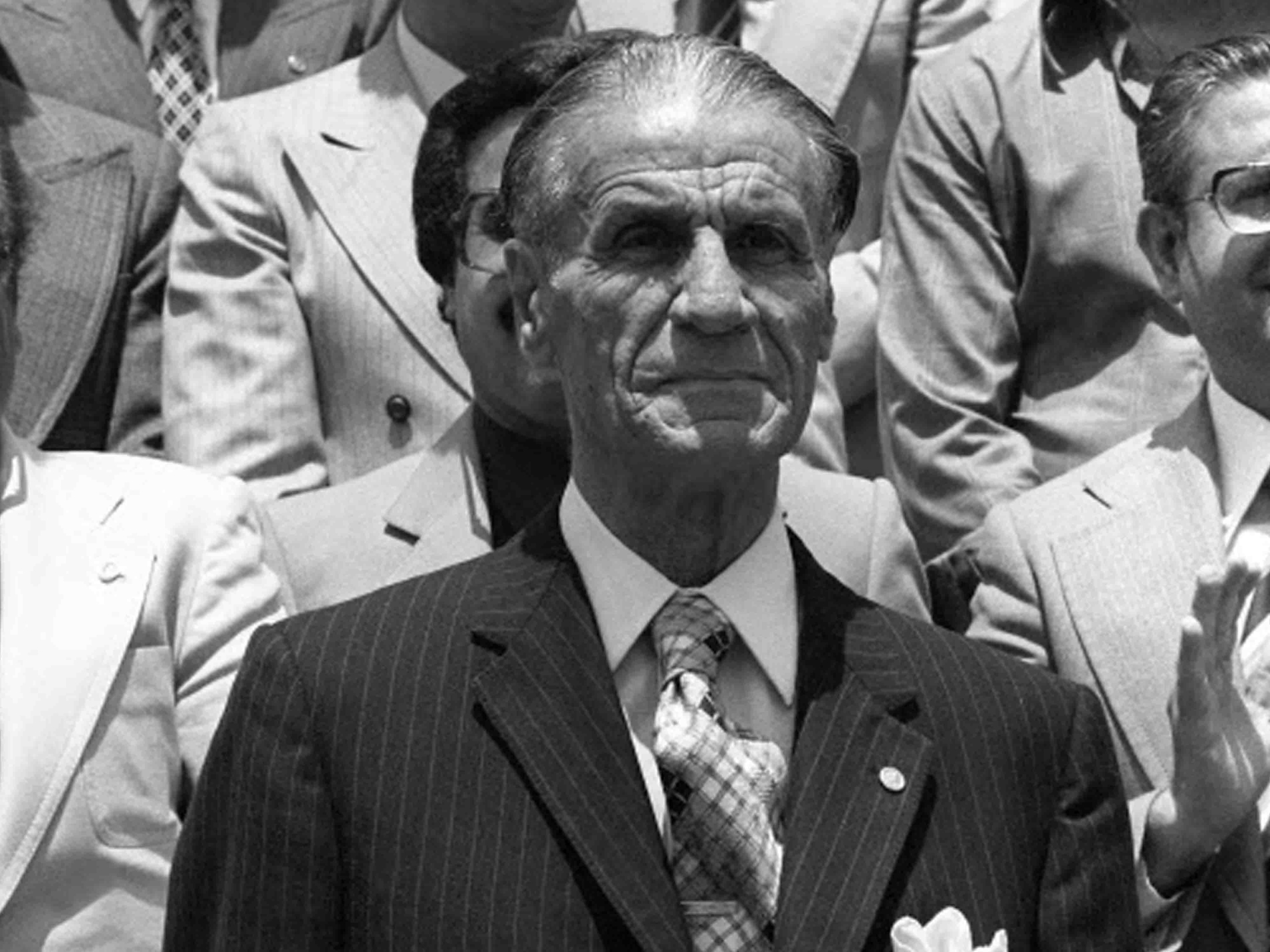
AFP
Pierre Gemayel, founder of the Lebanese Kataeb Party, attends a military parade in East Beirut on May 25, 1980.
I want to return to the national aspect. I am pleased to be speaking with a responsible Israeli figure in Israel, a messenger for the Israeli cause, and not just anyone. I said at the beginning of our conversation that we must understand one another. Because we were persecuted in the region, we made this country a country of freedom. In order for you to feel that you are in your own country, you have to feel, in your heart and in your beliefs, that the country is yours. The Christian feels that Lebanon is his country.
I want you to understand us and for us to understand you, because we are here—you and us—for eternity. We should not look at one another through a microscope. We must understand together that we have to live, that we have to come to an understanding, and that we have to help one another without getting into the details. Although sometimes the details are necessary for both sides, sometimes you or we have made mistakes; we are not gods. But we must move beyond that and rise to the national level. We work for Lebanon, and you work for Israel.
Since you came here to understand my point of view, I would say that the greatest service you can do for Israel is to understand the Lebanese, and for the Lebanese to understand the Israeli side. As an example, we are part of this Islamic world and of the Arab League. We helped establish the Arab League when the Ottoman Empire collapsed and discussions began about various forms of unity in the region. We wanted to be free, rather than enter into an Arab or Syrian union. Every country has its own problems. America has problems between blacks and whites; in Lebanon we have problems between Muslims and Christians—not as religious sects, but as civilizations.
Before Israel, we established Lebanon in 1943. In order to gain our independence, we were forced to reach an understanding with the Muslims, because without that there could be no independence.
We were aligned with the French, while they were aligned with the Arabs. We found ourselves compelled to reach an understanding with one another. Lebanon rejected every form of union and wanted to remain independent of both East and West. This is the Lebanese problem, which exists nowhere except Lebanon. Israel is Jewish, Syria is Islamic, whereas Lebanon is Lebanese. When you speak in its name, you have to speak on behalf of both the Muslim and the Christian.
I say this because you criticize us over Amin’s policy, but without that policy he would not have been able to sign the agreement with Israel. In Israel, there is a large segment of people who understand us deeply, and there is a good relationship with them. But there is also a segment that cannot understand how a Christian could not stand with Israel to the death, or fight a war alongside it. We fought the war for eight years on Israel’s behalf, but we managed to establish the understanding that eventually brought us to an agreement with Israel.
Who would have believed that one day we would extend our hand to Israel, sit with it at the same table, and see the Israeli flag flying here? It was because of this policy that we reached that point. You must help us with this, because without this policy Lebanon can move forward only through a Syrian or Arab union, and you would lose this strength on your side.
Let me give you the example of the Mountain. I know that the Jew is intelligent—20 million of you rule the world. I do not know how much it would be in your interest to establish an alliance between us and the Druze, because we are two minorities among Muslims. I do not know why you have not worked toward such an alliance, because Lebanese Christians and Lebanese Druze are the only communities that are not hostile toward you.
Before Israel, during the Ottoman period, everyone tried to look after himself. We succeeded in building this country, and at that time there was no Israel. Because it was in our interest to be part of the Arab world, and because many Lebanese work in the Arab world and considerable wealth comes to us from that world, I say that this relationship is sacred. We have a genuine interest in not creating hostility with them merely for the sake of hostility.
When Nasser wanted to establish the United Arab Republic, Lebanon did not dissolve into it. When circumstances required us to fight, we fought. Afterwards, Nasser became our friend when we understood one another and got to know each other. This is what I want to say: just as we came to understand Nasser, I am certain that Israel will understand us, because we will always need one another.
We are not a shop that we can close and move somewhere else. We and you are here forever. You cannot live forever with weapons in your hands, and you are trying to move closer to Islam. One day you will need a bridge between yourselves and the Arab world. That bridge exists: it is Lebanon.
For our part, we need someone to help us preserve our independence and sovereignty. During the recent events, Israel saved us. After eight years during which the entire world was afraid, Israel came and saved Lebanon, which had become an international center for terrorism.
Rabin: We appreciate Sheikh Pierre’s description, and we thank you for the philosophy you have presented and for the relationship you envision between Lebanon and Israel. You have represented the Lebanese conscience and way of thinking for many years, and you represent Christian courage. We want to strengthen that. You indicated that we should not expect too much from the president (Amin), or more than what he has given us in the form of a peace treaty or otherwise.
Pierre Gemayel (interrupting): The greatest achievement was the signing of this agreement, which represented all of Lebanon, and this was because of the policy pursued by Amin.
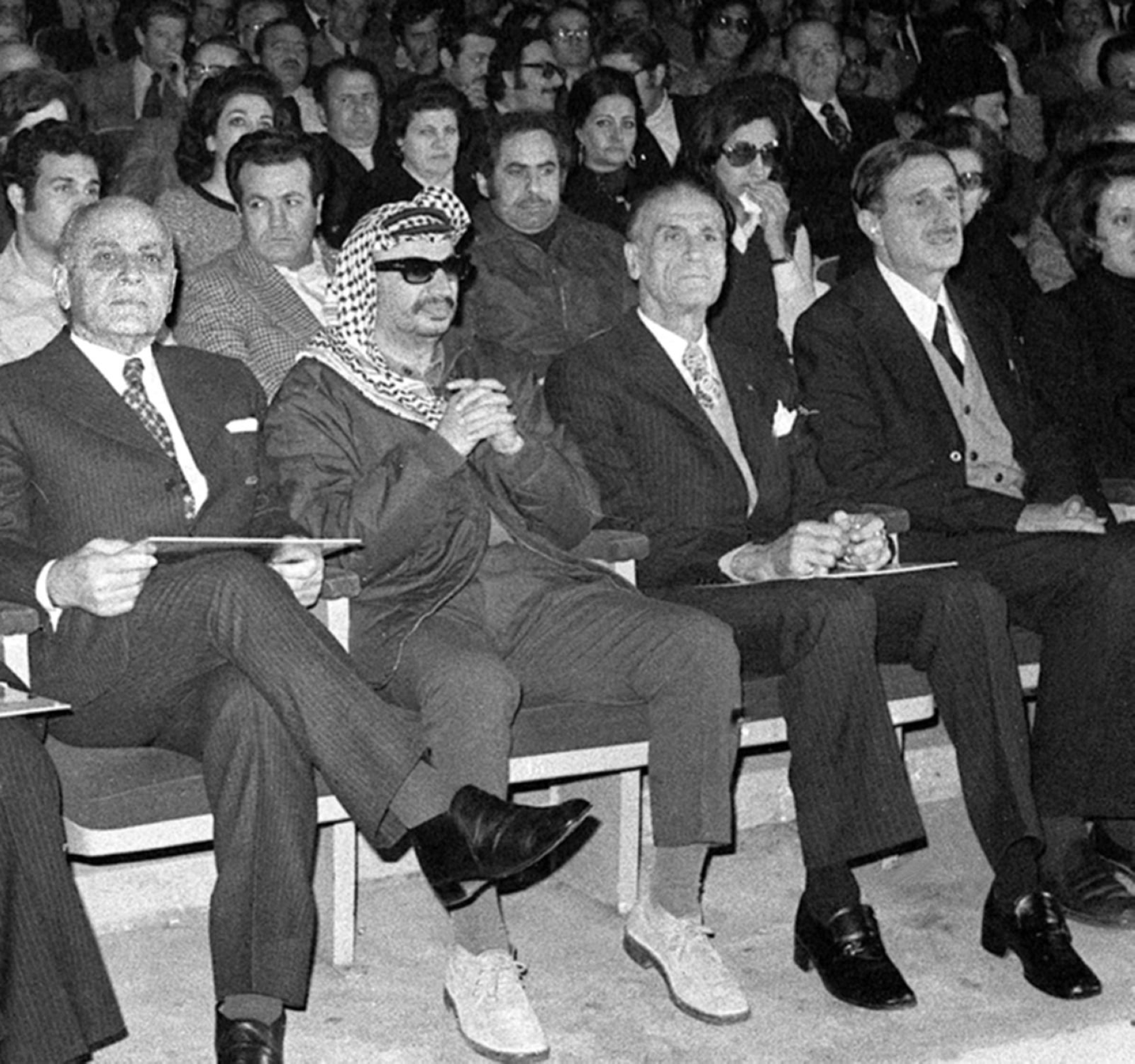
AFP
From left to right: Lebanese Prime Minister Saeb Salam, Palestinian leader Yasser Arafat, Christian leader Pierre Gemayel, and Druze leader Kamal Jumblatt, during an official ceremony in Beirut (undated archival photo from the early 1970s).
Rabin: We understood that, and we do not want to impose anything on anyone, even though we are strong. We do not want you to sever your relations with the Arabs. I was surprised that you asked us to solve the problem between the Druze and the Christians. We can provide assistance, but you have to solve the problem yourselves. You have been with them for hundreds of years, whereas we have been here for one year. We can create the conditions for such an agreement. The question in Israel is: How can we operate in Lebanon? How can we get the Syrians out? You have more contacts and better relations with the Syrians, and you are therefore in a better position to resolve this problem.
Pierre Gemayel: I completely understand what you are trying to say. But if you knew the Syrians, you would know that there was a problem concerning the customs and economic union between Lebanon and Syria, which ultimately ended with them accepting the situation. That is how they always are: they take several different positions. Even in their markets, there is no single price. When they used to come here, they were surprised that our shops had uniform prices. We are Europe, while they are part of the backward Arab world. There must be patience on your part, on our part, and on the Americans’ part. I believe the Americans have not lost hope. If they do, it will be a problem, because the Russians will take control of the entire Arab world. Syria is a special problem, and we can deal with it through patience, seriousness, and sustained effort.
Rabin: I know the Syrians very well. I was commander of the Northern Command from 1956 to 1959, and I know what the Syrians are like. When they say one thing, it means they will do the opposite.
Pierre Gemayel: That is what happened to me when we had good relations with the Syrians. What Hafez al-Assad used to tell me behind closed doors—I never expected them to do to us what they eventually did. But they did it.
Rabin: The Americans have not lost patience, but they lost a great opportunity eight months ago to get the Syrians out in August.
Pierre Gemayel: It was a very big mistake. They could have gotten them out, but the Americans prevented you from doing so. You were the masters of the field at that time. Everything you had sacrificed went to waste, because at that point you could have done whatever you wanted.
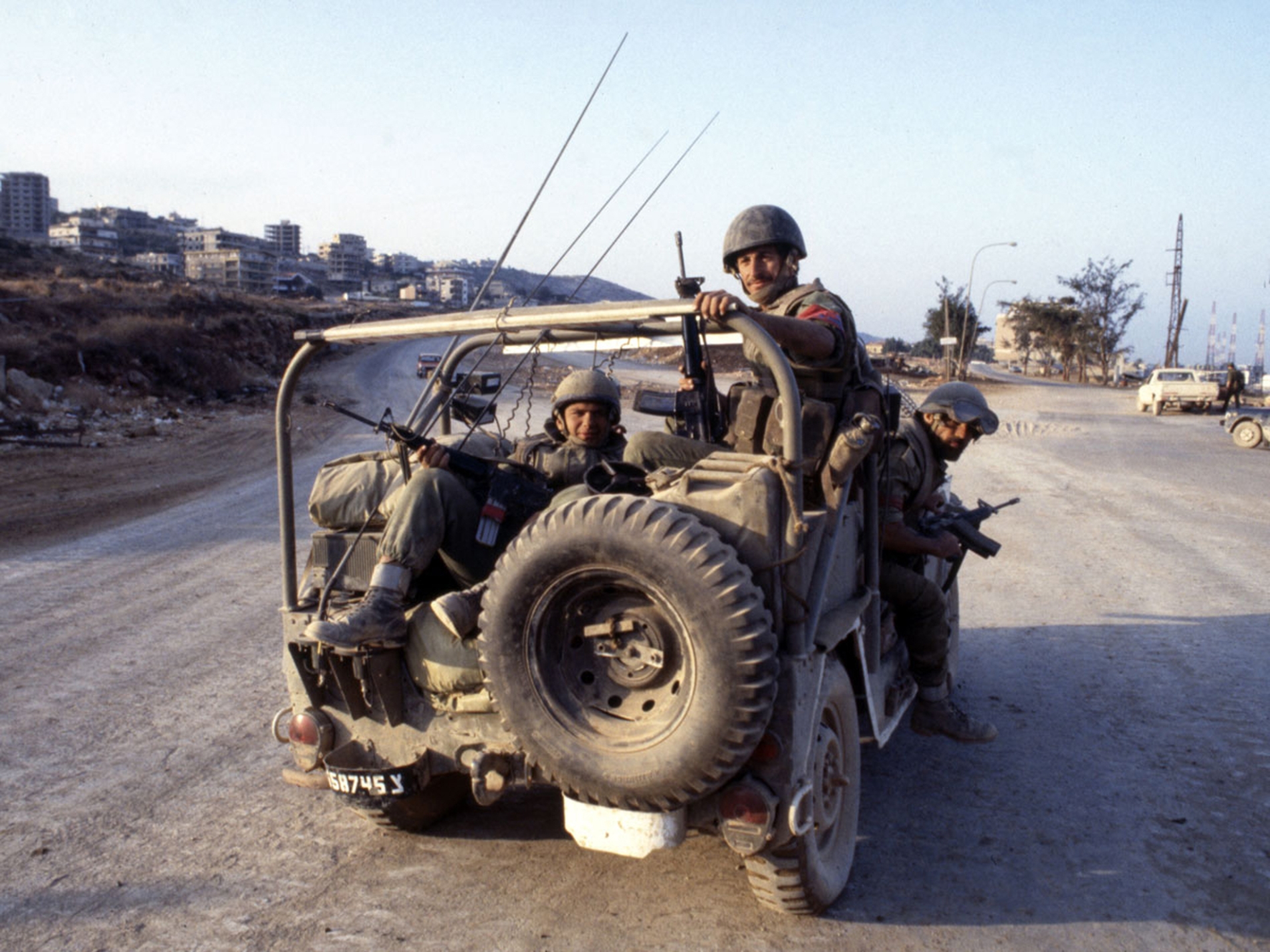
Getty Images
The Israeli army in the Chouf region of Lebanon during the 1983 invasion.