Al-Assad to Gemayel: “You can be assured that Syria today, and in the future as it has always done, will not leave Lebanon to bear the burden alone…”
Jean Obeid to Khaddam: “We have not undertaken anything with the Israelis without keeping you fully informed of everything.”

After Israeli and American pressure, the Lebanese and Israeli sides signed a peace agreement between them on May 17, 1983, in the presence of the U.S. Secretary of State. Lebanon thereby became the second country to sign such a treaty with Israel.
Khaddam says: “From the moment the American-Israeli negotiations began to take shape, we planned to bring them down because they created a dangerous situation in Lebanon and posed a direct threat to Syria.” He adds: “As we can see, less than a year later the agreement collapsed, and the balance of political and military power was restored.”
Khaddam returns to the period preceding the signing of the agreement, noting that “amid these events, in a country occupied by Israeli enemy forces and torn apart by civil war and the collapse of state and social institutions, Sheikh Amin Gemayel assumed the presidency of the Lebanese Republic following the death of his brother Bashir.” He adds: “We encouraged him to run for the presidency through contacts he had with us, conducted through certain security and military channels. Sheikh Amin Gemayel affirmed throughout all these contacts his commitment to the following principles:
- The unity and independence of Lebanon and its sovereignty over all its territory.
- Ending the Israeli occupation.
- Lebanon’s commitment to its Arab identity.”
According to Khaddam, he also affirmed that any negotiations he conducted concerning an Israeli withdrawal would be based on the following principles:
- Preserving Lebanon’s independence, unity, and sovereignty over all its territory.
- Preserving the national unity of the Lebanese people.
- Not undermining Lebanon’s Arab commitments or the security and interests of the Arab states.
“The issue of withdrawal was not to be considered before securing the withdrawal of the Israeli forces. Even if Syria wanted to withdraw its forces, you should ask it to remain so that you could use its presence as leverage to secure the withdrawal of the Israeli occupation forces.”
— Khaddam
Amin Gemayel, like Damascus, was keen to maintain communications through envoys whom he periodically sent to Damascus. Khaddam says:
“Mr. Jean Obeid was the first envoy President Gemayel sent after assuming the presidency. I received him on October 9, 1982, and during that meeting he raised the following issues:
- The possibility of my visiting Lebanon to congratulate Sheikh Amin on becoming president.
- A meeting on the border between President Hafez [al-Assad] and the Lebanese president.
- Partial withdrawals of the Syrian army from the Metn region, and an end to the armed Palestinian presence in that area.
- Discussing the possibility of a Syrian withdrawal from Lebanon and cooperating to expel the Israelis.
I replied that these issues required discussions within the leadership. Nevertheless, I could provide answers to some of them:
Regarding my visit to Lebanon: this was impossible under the prevailing circumstances because of the Israeli occupation. How could the Syrian foreign minister make such a visit under the protection of Israeli soldiers?”
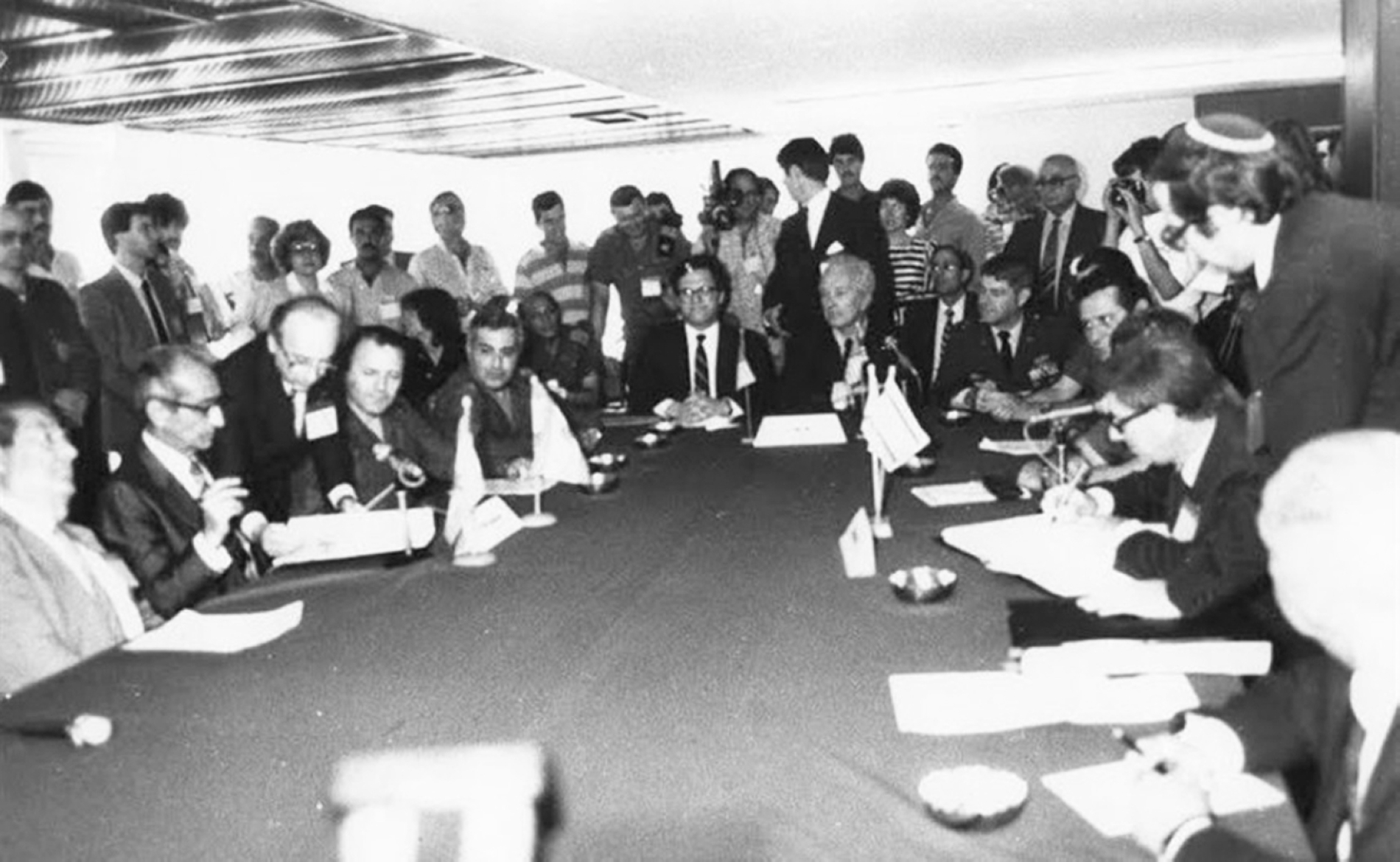
Getty Images
During the signing of the May 17, 1983 Agreement.
The issue of withdrawal was not to be considered before securing the withdrawal of the Israeli forces. Even if Syria wanted to withdraw its forces, you should ask it to remain so that you could use its presence as leverage to secure the withdrawal of the Israeli occupation forces.
The following day, I received Mr. Jean Obeid again. After discussing with President Hafez the issues he had raised, I asked Mr. Obeid whether Sheikh Amin was still insisting on a meeting at the border, or whether he had reconsidered the idea. We do not consider a meeting at the border appropriate. We welcome Sheikh Amin, and he will be warmly welcomed in Damascus, but meeting at the border is unacceptable.
Mr. Jean asked me what he should tell Sheikh Amin. I replied: “Tell him that Damascus is your city and that you will receive the reception befitting the President of Lebanon.”
As for the issue of a partial withdrawal, the matter was no longer one between us and you, but between us and Israel. Our presence on Lebanese territory no longer has the deterrent character it had in the past because of the Israeli presence. Therefore, we hope that our failure to withdraw now will not be interpreted as a refusal to respond to your request. Were it not for the Israeli presence, there would be no problem. We are ready to implement all the requests of the Lebanese government, but at present any movement would provide the Israelis with a military advantage.
On November 7, 1982, Brigadier General Mohammed Ghanem met with President Gemayel in his hometown of Bikfaya. He carried a message to President Hafez containing the following points:
First: President Amin Gemayel conveys his personal greetings to President Hafez al-Assad and regrets that the reply he sent to President Assad on September 29 did not arrive on time because of the negligence of an employee at one of the hotels in Damascus where the representative of the Lebanese state was staying. The Lebanese president is extremely keen to strengthen fraternal relations with President Assad, and his recent initiative to release some Lebanese detainees from Syrian prisons had a very positive effect on the Lebanese president. The Lebanese president would have liked to visit the Syrian president were it not for circumstances of which you are aware. Nevertheless, he looks forward to a productive meeting at a mutually agreed time in the near future.
Second: President Gemayel did not wish to wait for the meeting before informing President Assad about the negotiations beginning this week with the Israeli side. These negotiations are a continuation of meetings that had been held by a Lebanese military field committee tasked with arranging the situation in Lebanon following the Israeli invasion. The field committee is now resuming its activities, supplemented by legal advisers, in order to address the Israeli withdrawal from Lebanon. This is being carried out with direct American support and with the participation of an American official to facilitate the withdrawal.
The Lebanese side insists on the following:
- A complete Israeli withdrawal and the extension of the authority of the Lebanese Army, and no other force, over all Lebanese territory. This is the established Lebanese position.
- Rejecting the conclusion of a peace or reconciliation agreement with Israel and adhering to the Armistice Agreement concluded in 1949.
- The negotiations will take place within the framework of the military field liaison committee and will aim to revive the Armistice Agreement, possibly in an amended form.
- An American team will participate in the negotiations, continuing the mission it has been carrying out since June, which contributed to saving Beirut, and about which they have continued to keep you informed.
Third: President Gemayel, as does the Lebanese government, thanks President Assad, on behalf of the Lebanese people as a whole, for his position responsive to Lebanon’s interests. We consider that, since President Assad has declared that the Syrian Army is prepared to leave Lebanese territory within a certain framework, it is natural that this should not require Lebanese-Syrian negotiations similar to those currently taking place because of the Israeli invasion.
Fourth: We are awaiting from the Israeli side a comprehensive timetable for the complete withdrawal of the Israeli Army from Lebanon, beginning with the mountains and part of the south. We are attempting to expand the area covered to the maximum extent and to make this phase take place immediately. We will remain in contact with you to inform you of developments, with the aim of facilitating the deployment of the multinational force in light of these withdrawals.
This might lead to a request for the Syrian Army to cooperate and withdraw from certain positions to facilitate the deployment of those forces. This, of course, would not require negotiations, but rather arrangements for communication and coordination of positions. Other arrangements relating to matters of mutual concern, including security and other issues, would be addressed in a renewed, sincere effort to build relations on sound foundations of mutual respect for sovereignty, together with measures falling within the framework of fraternal relations. All of this will be discussed at the meeting we anticipate taking place soon between the Syrian and Lebanese presidents.
Fifth: Lebanon expects sisterly Syria to help it reach a common understanding with the Palestinian side, in order to facilitate the Lebanese government’s task of extending its sovereignty over all Lebanese territory.
Naturally, Lebanon will keep Syria periodically informed of developments in Lebanese-Palestinian relations, which have so far remained at a preliminary stage and have not reached the desired level.
Finally, the Lebanese president informs President Assad that his visit to Morocco was intended to learn the outcome of the contacts undertaken by King Hassan II on behalf of the Arab League and the Fez Conference in New York and Washington, following an invitation extended to the Lebanese president by King Hassan II. King Fahd has also invited the Lebanese president, who will accept the invitation in the near future. He will inform the Syrian president of the outcome of that visit, out of his concern for strengthening fraternal relations between himself and President Assad, and between the Syrian and Lebanese peoples, given the ties of good-neighborliness and special brotherhood between them.
President Gemayel requests that President Assad provide a written response to this message as soon as appropriate, given the rapid pace of events and the limited time available, and that the response be conveyed through Colonel Mohammed Ghanem.
On December 16, 1982, President Hafez al-Assad received Mr. Jean Obeid, an envoy of President Gemayel, to brief him on the ongoing discussions concerning the Israeli withdrawal from Lebanon.
He informed President Hafez of the following Israeli demands of Lebanon, as conveyed by Philip Habib:
- That the Israelis have a position on Mount Barouk and in the Chouf, with a corridor to this position extending from the coastal road to the Damour Bridge and then to Barouk, passing through Deir al-Qamar.
- That the Lebanese borders be opened to Israeli goods, merchandise, and products.
- That Israel have a quasi-diplomatic office in Lebanon, with a corresponding Lebanese center in Israel.
- That Israel have the right to monitor Lebanese territorial waters and air traffic.
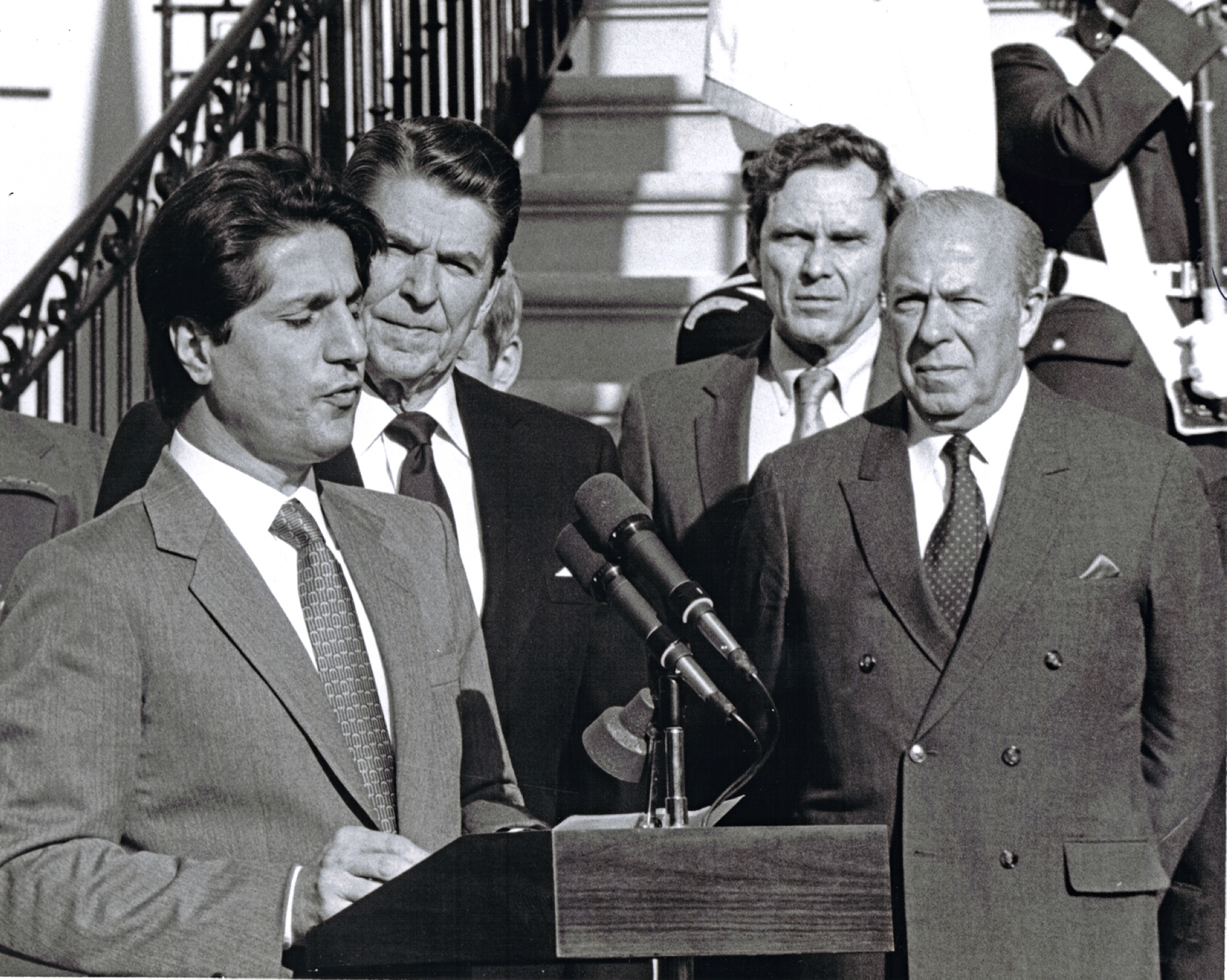
Getty Images
Lebanese President Amin Gemayel speaks outside the White House on December 1, 1983. Also pictured are U.S. President Ronald Reagan and Secretary of State George Shultz.
The president was handed the following letter from Sheikh Amin:
“Mr. President,
Brotherly greetings,
The recent developments in the region have placed the crisis in the region, and our cause in Lebanon in particular, in a delicate and dangerous situation.
In the efforts we have made over the past few weeks to save Lebanon, we have faced a series of demands and obstacles that have risen and fallen according to a plan aimed at prolonging the occupation of our land and exploiting it to bring about the destruction of the country, and through it, the destabilization of the neighboring countries and the entire Arab region.
Mr. President,
Out of my conviction that Lebanon is not alone in confronting the grave dangers and pressures bearing down upon it; in keeping with the principles of brotherhood that oblige us to deal with matters concerning our common destiny in the spirit and conduct of a united front; and from my certainty that confronting this stage and meeting its obligations is neither within Lebanon’s capacity nor solely its responsibility, especially since its repercussions will not be confined to Lebanon alone, I have therefore decided to apprise Your Excellency of the circumstances surrounding our cause and the crisis in the region.
For this purpose, I have entrusted Mr. Jean Obeid with the task of briefing you on the latest developments in our international and Arab efforts and initiatives, and of seeking your views on how to overcome the present grave impasse.
Allow me, Mr. President, to affirm to you that, amid all this and under all circumstances, Lebanon remains firmly committed to its dignity and legitimate national rights, and equally committed to the dignity and legitimate rights of its brothers in all the positions it takes and steps it undertakes.
It is also important to me to convey to Your Excellency our openness to any initiative or contact, at any level, that may be required to achieve our national and common objectives.
I am confident that the entire Arab family, and brotherly Syria under your leadership in particular, will not spare any opinion, decision, or measure that could put an end to Lebanon’s ordeal, help it regain its full sovereignty, and safeguard the unity of its territory—thereby strengthening its ability to defend the Arab cause and confront the challenge that encompasses all Arab states.
Pending that, please accept, Mr. President, my esteem, affection, and wishes for your continued success and prosperity, and for the continued success and prosperity of brotherly Syria.”**
During this meeting, Jean told President Hafez [al-Assad]: “We would like to benefit from your experience in negotiating with the Israelis and to know your opinion.” The president replied that Syria had not negotiated with the Israelis. “If you are referring to the troop-disengagement negotiations, those took place through the Americans. If I were Sheikh Amin, I would not enter into negotiations, because he would be negotiating while Israeli tanks are sitting in the courtyard of his palace, and the Israeli army is occupying his capital with the support of the United States. What bargaining cards does Lebanon have to use at the negotiating table?
“Right now, world public opinion is on your side and is exerting considerable pressure on the United States and Israel. If you sit down at the negotiating table, that pressure will recede, and people will say, ‘Let us see what happens.’ At the same time, Israel will have succeeded in cleaning up its image before the world.
“The matter requires keeping one’s nerves under control and organizing the work and effort in order to force Israel to withdraw. But if you sit down at the negotiating table, Israel will put forward all its demands. And the minimum of the Israeli demands will come at the expense of Lebanon’s independence and sovereignty, as well as the security and interests of the Arabs. That is our view.”
That same afternoon, Khaddam received Jean Obeid and handed him Assad’s reply to Sheikh Amin Gemayel’s letter. It read:
“Mr. President,
Brotherly greetings,
I received with great pleasure your letter dated the 15th of this month, delivered by your envoy, Mr. Jean Obeid, in which you described the current situation in Lebanon and its suffering under the Israeli occupation, as well as Israel’s objectives and conditions.
Proceeding from the brotherhood that binds the two twin countries and from our common destiny, I wish to affirm to you that Syria stands alongside Lebanon under your leadership in confronting the mounting dangers, which threaten not only Lebanon but Syria and all the Arabs.
It is now beyond doubt that the targeting of Lebanon at this stage, the effort to entrench the occupation, tear apart its national unity, and impose impossible conditions that undermine its independence and the unity of its national territory, as well as the absolute sovereignty of the Lebanese state over all its territory, are being pursued by the Israeli enemy as part of its expansionist policy and aggressive objectives—not against Lebanon alone, but against the entire region.
Mr. President, you can be assured that Syria, today and in the future, as it has always done, will not leave Lebanon to bear the burden alone in confronting what threatens it and threatens its unity, sovereignty, and independence. Rather, you can be certain that we stand with you, because our destiny is shared, our cause is one, and our hopes and suffering are one.
Your envoy, Mr. Jean Obeid, has briefed me on the circumstances and the latest developments. This has confirmed to me what is in fact taking place: that the Lebanese state in general, and Your Excellency in particular, will not yield to Israeli blackmail, nor will you accept sacrificing the dignity, sovereignty, and future of our beloved homeland, Lebanon.”
And Syria, as you know it, will not hesitate to take any measure or decision that may help you confront the grave situation that we are all facing, proceeding from our conviction in the unity and independence of Lebanon, the right of the Lebanese state to exercise its sovereignty over all Lebanese territory, and Syria’s national role in supporting this.
Allow me to express once again my relief and satisfaction with the contents of your letter. I also agree with you on the importance of maintaining communications, meetings, and coordination between us.
You will find, Mr. President, our full support, assistance, and participation in confronting this ordeal, which is the ordeal of us all, and in confronting the grave dangers sweeping the region as a result of Israeli aggression against Lebanon and all the Arabs.
Finally, I send you my warmest greetings and sincere good wishes, both personally to you and to the dear brotherly people of Lebanon.
During the negotiations, Sheikh Amin Gemayel sent Mr. Jean Obeid to Damascus many times to brief us on the course of what was taking place between the Lebanese government, the Israelis, and the Americans. However, what Mr. Obeid conveyed did not go beyond what was being reported in the newspapers. On every occasion, he emphasized that Lebanon would not sign an agreement that compromised its sovereignty and independence, granted gains to Israel, or caused harm to the Arab world or to Syria’s security and interests.
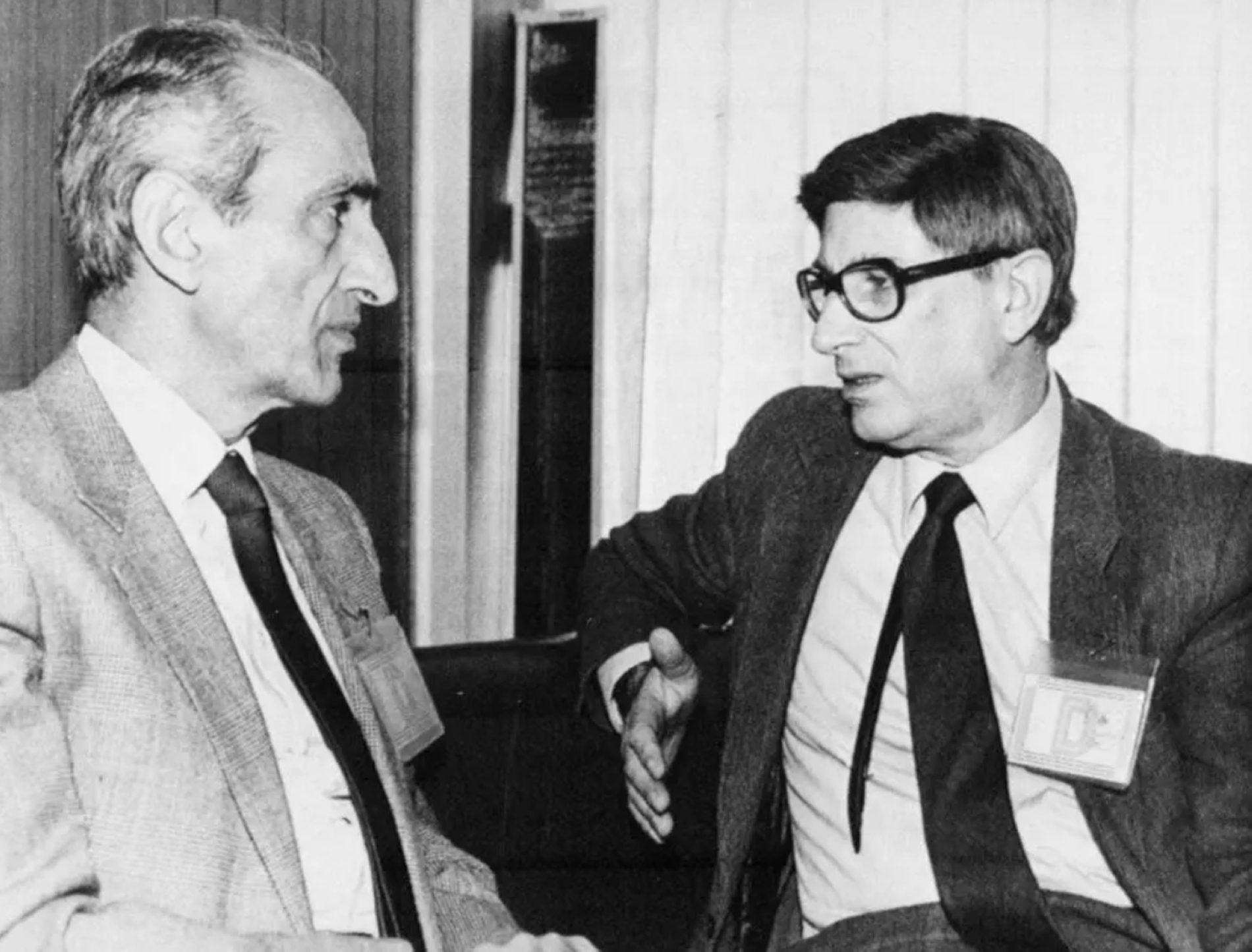
AP
Israeli negotiator David Kimche gestures while speaking with Antoine Fattal, the senior Lebanese negotiator, in Khaldeh, Lebanon, on March 1, 1983.
I said to him: “Let us assume that they want Lebanon to remain a single state!”
Mr. Jean explained the situation, saying: “As far as the Americans are concerned… As for the Israelis, they know what they can obtain with the Americans’ support while keeping Lebanon as a single state. I do not imagine that the Israelis want Lebanon to remain a single state, but no matter how far the Americans are prepared to go, there is a minimum they can say. In other words, if Lebanon is going to disintegrate, it will be the result of Israeli pressure and a complicit American position—there is no third reason. The last thing Sheikh Amin asked me to convey was that there is an Israeli assurance that Syria will not withdraw… There is American doubt about a Syrian withdrawal, and Palestinian opposition to a Syrian withdrawal.”
After reviewing the situation in Lebanon and what the Lebanese Army and the Lebanese Forces had done in West Beirut and the refugee camps, I told Mr. Jean Obeid that any discussion between us and you was completely settled: Syria does not provide, and cannot provide, a pretext for the Israelis to remain in Lebanon. But we want to know what you have done with the Israelis, how far you have gotten, and what you have agreed with them.
He replied: “We have not done anything with the Israelis without informing you of everything.”
I showed him an American memorandum addressed to us. It read:
It is important to recognize the interrelationship among the various subjects on the different agendas, and the manner in which an Israeli withdrawal can be achieved, and Lebanese authority restored generally throughout all of Lebanon, through a comprehensive agreement. Such an agreement would encompass security arrangements, the withdrawal of Syrian forces and PLO forces, as well as Israeli forces, and the establishment of new relations between Lebanon and Israel, so that all of these would constitute new elements… Establishing new relations between Lebanon and Israel is logical, and such relations would result in, as Lebanon establishes in the negotiations, appropriate arrangements that would eliminate and remove any cause for military confrontation by either side. Lebanon would also obtain guarantees against interference in its internal affairs.
We responded with the following statement setting out the position of the Government of the Syrian Arab Republic regarding the substance of the American memorandum:
1. The Government of the Syrian Arab Republic reaffirms its positions, which it has stated on numerous occasions, namely its rejection of any agreement that infringes upon Lebanon’s independence and sovereignty and the unity of its territory, as well as the security and interests of Syria and the other Arab states. In other words, we will reject any agreement that contradicts this principle.
2. The Government of the Syrian Arab Republic rejects the inclusion of the withdrawal of its forces from Lebanon in the negotiations currently under way, for the following reasons:
a. Syria is not a party to the negotiations.
b. The Syrian forces operating in Lebanon are not foreign forces, and the basis for their presence in Lebanon and their missions there are entirely different from the presence of the Israeli occupying forces.
3. The memorandum referred to the importance of reaching a comprehensive agreement between Israel and Lebanon and establishing new relations between them. This contradicts the assurances previously given by Secretary [of State George] Shultz during his meeting with Ministers Abdul Halim Khaddam and Prince Saud al-Faisal in Washington the previous year, when Mr. Shultz affirmed that the United States opposed imposing a peace treaty between Israel and Lebanon, in addition to its attempt to impose such an agreement under the pretext of the Israeli occupation.
The memorandum also recalls the agreements signed by the Nazis during the Second World War, and therefore suggests that such an agreement would not be legitimate. This likewise contradicts statements made repeatedly by Mr. Philip Habib, in which he affirmed that Israel wanted only security measures from Lebanon in the southern part of the country. In other words, the Americans are saying that these negotiations will result in new relations between Lebanon and Israel.
We did not get this information from The New York Times or The Washington Post. We got it from a memorandum from the American Embassy. That is why you came to us asking questions about the unknown, while we gave you our position regarding what is known.
I continued: You have seen the President roughly twice, received a written message from him, and received statements from me. So, if there really are security arrangements, and we feel that they infringe upon Lebanon’s independence and that they will impose structures, leaders, and political figures on Lebanon, then we will resist these arrangements to the very end. Otherwise, Lebanon would become an Israeli protectorate.
Lebanon, for us, is not Jordan or Sinai. There is hardly a Syrian household without a Lebanese man or woman, and hardly a Lebanese household without a Syrian man or woman. In such a situation, we would need twenty counterintelligence agencies to deal with the Israeli espionage that would come to us through Lebanon. Therefore, we are telling you: Syria cannot be used as a pretext for Israel to remain in Lebanon. Syria will not remain in Lebanon for a single hour once you inform us that Israel is withdrawing.
But if you reach an agreement that contains gains for Israel, the normalization of relations, and an end to the state of war, and then say, “Here is Israel withdrawing; now you Syrians, please leave,” then we will discuss the matter with you on a different basis. And it will not be only us; the Lebanese themselves will discuss it with you on a different basis.
We know what Israel has demanded, but we do not know what it has accepted.