Khaddam “Steals” the Text of the Lebanese-Israeli Agreement from Elie Salem (6 of 6)

publisher: AL MAJALLA

AUTHOR: ابراهيم حميدي

Publishing date: 2026-05-21

Facebook
Twitter
LinkedIn
WhatsApp
Khaddam to Assad: “Welcoming Gemayel will lead to his rescue and the frustration of the opposition” … Ghazi Kanaan, quoting Suleiman Frangieh: “Amin Gemayel is not the decision-maker”
"المجلة"

After an exchange of letters between Presidents Amin Gemayel and Hafez al-Assad, the former called the latter on May 1, 1983, and asked him to agree to receive Foreign Minister Dr. Elie Salem, in order to brief him on the stage reached in the Israeli-Lebanese negotiations.

Syrian Vice President Abdul Halim Khaddam says: “On May 2, 1983, I went to Mezzeh Airport and received the Lebanese minister. Then, on May 12, 1983, I received Dr. Salem, accompanied by Colonel Saeed Qaquor, to brief us on the draft agreement that had been reached with the Israelis and the Americans.

“After exchanging the usual courtesies, Minister Salem told me that he was carrying a copy of the agreement, and that the Council of Ministers had not yet seen it. He said, ‘I will go through it with you word by word and take it back with me. This is a preliminary version; tomorrow or the day after, we will have the final version, and I will come and give you the final copy.’

“I asked him to have the agreement photocopied. He said, ‘Read it and I will take it back with me, or, if you wish, I can read it myself and stop wherever you want.’

“I told Minister Salem that my memory is visual rather than auditory, so he should give me the agreement and let me read it myself. When he handed it to me, I called the secretary and gave him the agreement to photocopy. Dr. Salem tried to take it back from him but could not. Thus, amid both seriousness and joking, I obtained a copy of the agreement and began reading it. It stated as follows:

Agreement Between the Government of the Republic of Lebanon and the Government of the State of Israel

The Government of the Republic of Lebanon and the Government of the State of Israel, recalling the importance of preserving and strengthening international peace based on freedom, equality, justice, and respect for fundamental human rights; proceeding from their belief in the legitimate purposes and principles of the United Nations; and acknowledging their right and duty to live in peace with all states and with each other within secure and recognized boundaries; agreeing to declare an end to the state of war between them; and desiring to establish lasting security for their two countries and to prevent threats and the use of force between them;

Desiring to establish their mutual relations in the manner set forth in this Agreement, and having furnished their undersigned plenipotentiary representatives with full powers to sign this Agreement, in the presence of a representative of the United States of America,

Have agreed to the following provisions:

Article I

  1. Each of the parties undertakes to respect the sovereignty, political independence, and territorial integrity of the other party. They regard the existing international boundary between Lebanon and Israel as inviolable.
  2. The two parties affirm that the state of war between Lebanon and Israel has ended and no longer exists.
  3. Pursuant to the provisions of paragraphs 1 and 2, Israel undertakes to withdraw its armed forces from Lebanon in accordance with the Annex to this Agreement.

Article II

The two parties, guided by the principles of the United Nations Charter and international law, undertake to settle their disputes by peaceful means and in a manner that promotes international justice, peace, and security.

Article III

In order to provide the maximum possible security for Lebanon and Israel, the two parties shall establish and implement security arrangements, including the establishment of a security zone, in accordance with the provisions of the Annex to this Agreement.

Article IV

  1. Neither party shall use the territory of the other as a base for hostile or terrorist activity against the other party or its people.
  2. Each party shall prevent the presence or establishment of irregular forces, armed groups, organizations, bases, offices, or structures whose objectives or purposes include launching attacks against the territory of the other party, carrying out terrorist acts within that territory, or engaging in any activity intended to threaten or endanger the security of the other party or the safety of its inhabitants. To this end, all agreements and arrangements authorizing the presence and operation of elements hostile to the other party within the territory of either party shall become null and void and shall have no legal effect.
  3. While retaining its inherent right of self-defense in accordance with international law, each party shall refrain:

    a. From carrying out, encouraging, assisting, or participating in threats or acts of war, subversion, incitement, or aggression against the other party, its inhabitants, or its property, whether within its own territory, originating from it, or within the territory of the other party.

    b. From using the territory of the other party to launch a military attack against the territory of a third state.

    c. From interfering in the internal or external affairs of the other party.
أ.ف.ب

AFP

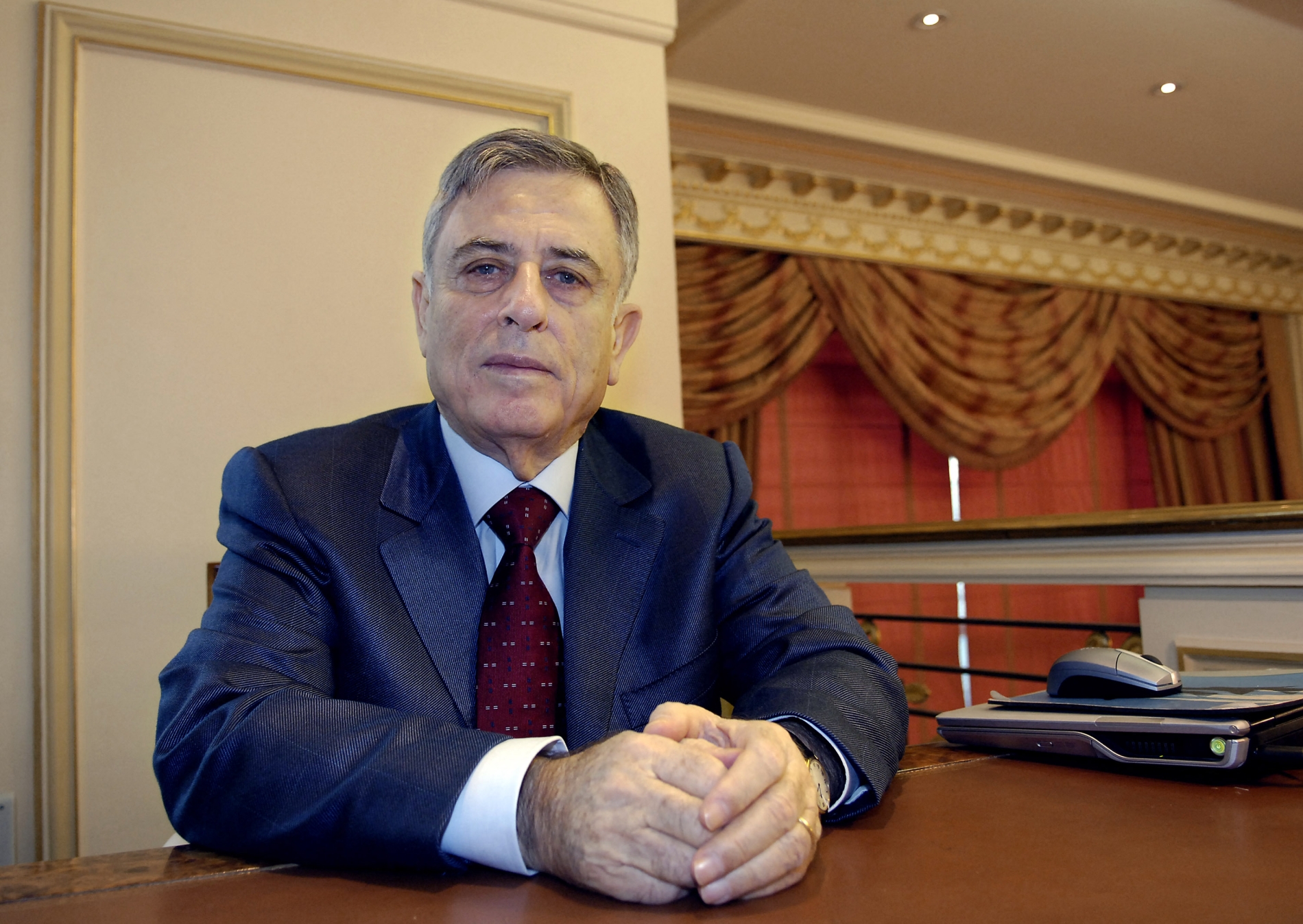
Abdul Halim Khaddam, Syria, April 7, 2001.

  1. Each party undertakes to take preventive measures and legal action against persons and groups that commit acts in violation of the provisions of this article.

Article Five:

Consistent with the termination of the state of war, each party shall, within the framework of its constitutional system, refrain from any form of hostile propaganda against the other party.

Article Six:

Each party shall prevent military forces, equipment, or military materiel belonging to any state hostile to the other party from entering, being deployed in, or transiting through its territory, including its airspace and territorial waters, except for the right of innocent passage in accordance with international law.

Article Seven:

Except as provided for in this Agreement, nothing shall prevent, at the request and with the consent of the Lebanese Government, the deployment of international forces on Lebanese territory to assist the Lebanese Government in establishing its authority. The states that subsequently contribute to these forces shall be selected from among states maintaining diplomatic relations with both parties.

1 — a. As soon as this Agreement enters into force, the parties shall establish a Joint Liaison Committee, which shall begin exercising its functions upon its establishment. The United States of America shall participate in the Committee. The Committee shall be entrusted with overseeing the implementation of this Agreement in all its aspects. With regard to matters covered by the security arrangements, the Committee shall address unresolved issues referred to it by the Security Arrangements Committee established under paragraph (c) below. The Committee shall take its decisions by consensus.

b. The Joint Liaison Committee shall continuously concern itself with the development of relations between Lebanon and Israel, including the regulation of the movement of goods, products, and persons, transportation, etc.

c. Within the framework of the Joint Liaison Committee, a Security Arrangements Committee shall be established, whose composition and functions are defined in the Annex to this Agreement.

d. Subcommittees of the Joint Liaison Committee may be established as necessary.

e. The Joint Liaison Committee shall meet alternately in Lebanon and Israel.

f. Either party, if it so wishes, and unless an agreement is reached to alter the legal status, may establish a liaison office on the territory of the other party to carry out the above-mentioned functions within the framework of the Joint Liaison Committee and to assist in implementing this Agreement.

g. A senior government official shall head each party’s delegation to the Joint Liaison Committee.

h. All other matters concerning these liaison offices and their personnel, as well as personnel belonging to either party who are present on the territory of the other party for reasons related to the implementation of this Agreement, shall be addressed in a protocol to be concluded between the parties within the Joint Liaison Committee. Pending the conclusion of such a protocol, the liaison offices and the personnel referred to above shall be treated in accordance with the relevant provisions of the Convention on Special Missions of December 8, 1969, including its provisions concerning privileges and immunities. Nothing above shall prejudice any reservations the parties may have regarding that Convention.

2 — During the six-month period following the withdrawal of all Israeli armed forces from Lebanon in accordance with Article One of this Agreement, and following the simultaneous restoration of Lebanese governmental authority along the international border between Lebanon and Israel, and in light of the termination of the state of war, the parties shall, within the framework of the Joint Liaison Committee, begin negotiations in good faith with a view to reaching agreements concerning the movement of goods, products, and persons, and shall implement them on a non-discriminatory basis.

Article Nine:

1. Within a period not exceeding one year from the entry into force of this Agreement, each party shall take all necessary measures to repeal treaties, laws, and regulations that are deemed incompatible with this Agreement, in accordance with and subject to its respective constitutional procedures.

2. The parties undertake not to implement any existing obligations that conflict with this Agreement, nor to enter into any obligation or adopt any laws or regulations that conflict with this Agreement.

Article Ten:

1. This Agreement shall be concluded by the parties in accordance with the constitutional procedures applicable to each of them and shall enter into force upon the exchange of instruments of ratification. It shall supersede previous agreements between Lebanon and Israel.

2. All annexes to this Agreement—namely, the Annex, Appendix, and map, as well as the agreed interpretative records—shall constitute an integral part of the Agreement.

3. This Agreement may be amended, revised, or replaced with the consent of both parties.

Article Eleven:

1. Disputes arising from the interpretation or application of this Agreement shall be settled through negotiation within the Joint Liaison Committee. Any such dispute that cannot be resolved in this manner shall be submitted to conciliation and, if still unresolved, shall be submitted to an agreed procedure for final settlement.

2. Notwithstanding the provisions of paragraph 1, disputes arising from the interpretation or application of the Annex shall be resolved within the Security Arrangements Committee. If this cannot be achieved, the dispute shall, at the request of either party, be referred to the Joint Liaison Committee for resolution through negotiation.

Article Twelve:

This Agreement shall be communicated to the Secretariat of the United Nations for registration in accordance with Article 102 of the Charter of the United Nations.

This Agreement was signed at Khaldeh and Kiryat Shmona on the ___ day of May 1983, in three copies in four official languages—Arabic, Hebrew, French, and English. In the event of any difference in interpretation, the English and French texts shall have equal authority.

For the Government of the Lebanese Republic
For the Government of the State of Israel
In the presence of the United States of America

Annex on Security Arrangements

1 — The Security Zone:

a. A security zone shall be established, within which the Lebanese Government undertakes to implement the security arrangements agreed upon under this Annex.

b. The security zone shall be bounded, as shown on the map attached to this Annex, to the north by a line designated as Line (A) on the attached map, and to the south and east by the international Lebanese border.
غيتي

Getty

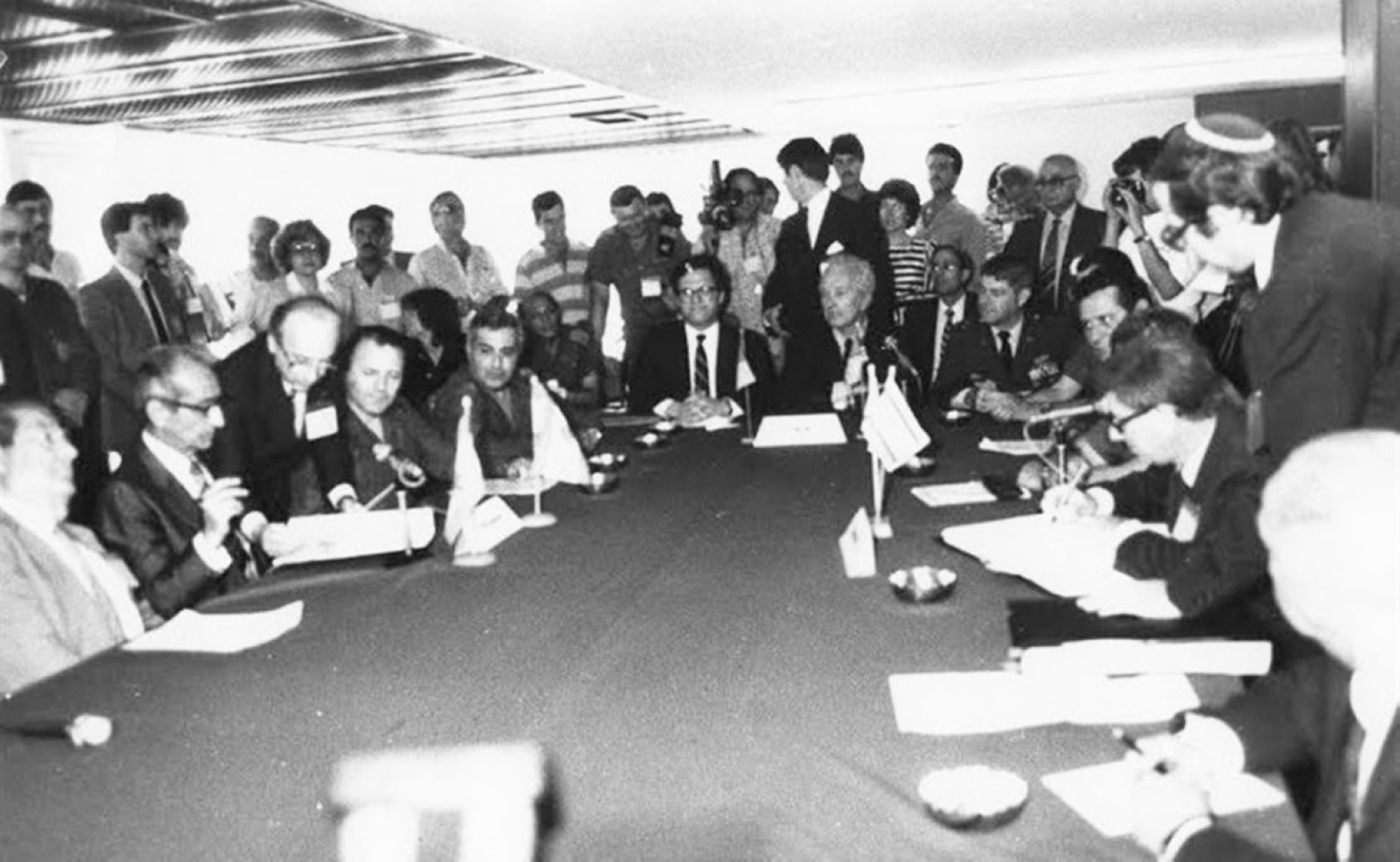
During the signing of the May 17, 1983 agreement.

2 — Security Arrangements:

The Lebanese authorities shall take special security measures to detect and prevent hostile activities, as well as to detect and prevent the entry or movement of unauthorized armed personnel and the entry or movement of unauthorized military equipment within the security zone or elsewhere. Except for the exceptions provided for, the following security arrangements shall apply throughout the entire security zone:

a. The only organized armed forces and personnel permitted in the security zone shall be the Lebanese Army, the Lebanese Police and Internal Security Forces, and the Lebanese auxiliary forces—the Ansar—established under the full authority of the Lebanese Government, except as otherwise provided elsewhere in this Annex. The Security Arrangements Committee may approve the deployment in the security zone of other similar Lebanese armed personnel belonging to the Ansar.

b. There shall be no numerical limits on the Lebanese Police, Internal Security Forces, and Ansar stationed in the security zone. These forces and personnel shall be equipped with individual light automatic weapons, while the Internal Security Forces shall also be equipped with reconnaissance or commando armored vehicles, as specified in the Appendix.

c. Two Lebanese Army brigades shall be stationed in the security zone. One shall be a territorial brigade whose area of operations shall extend from the Lebanese-Israeli border to Line B shown on the attached map. The second shall be a regular brigade stationed in the area extending from Line B to Line A. These two brigades may possess the organic weapons and equipment listed in the Appendix. Subject to arrangements established by the Security Arrangements Committee, additional units equipped in accordance with the Appendix to this Agreement may be deployed in the security zone for training purposes, including recruit training, or in cases of operational emergency.

d. The local units currently in existence shall be incorporated into the Lebanese Army in accordance with the applicable regulations of the Lebanese Army. The existing local civil guard shall likewise be incorporated into the Ansar and granted the appropriate status under Lebanese law, enabling it to continue guarding the villages within the security zone. The process of extending Lebanese authority over these units and the civil guard, under the supervision of the Committee, shall begin immediately after the Agreement enters into force and shall be completed before the Israeli withdrawal from Lebanon is completed.

e. Lebanese Army units may retain within the security zone their organic anti-aircraft weapons, as specified in the Appendix. Outside the security zone, Lebanon may deploy shoulder-fired air-defense missiles and short- and medium-range missiles. After three years from the date this Agreement enters into force, the Security Arrangements Committee may redeploy them, at the request of either party, in accordance with arrangements concerning the area outside the security zone.

f. Military electronic equipment in the security zone shall be that specified in the Appendix to this Agreement. The deployment of ground-based radar within ten kilometers of the Lebanese-Israeli border shall require the approval of the Security Arrangements Committee. Throughout the security zone, such radars shall be deployed so that their detection sector does not extend beyond the Lebanese-Israeli border. This requirement shall not apply to radars used for monitoring civil aviation or air transport.

g. The requirement set out in paragraph (e) shall also apply to anti-aircraft missiles carried aboard vessels of the Lebanese naval forces within the security zone. Lebanon may deploy naval units and establish and maintain naval bases or other coastal installations required for the performance of its naval mission. Coastal installations within the security zone shall be determined in accordance with the Appendix to this Agreement.

h. In order to prevent incidents arising from mistaken identification, the Lebanese military authorities shall provide advance notification of all flights of any kind over the security zone, according to procedures established by the Security Arrangements Committee. Such flights shall not require approval.

i.

  1. The military forces, weapons, and military equipment that may be introduced into, stationed or stored within, or transported through the security zone shall be those specified in this Annex and its Appendix.
  2. No auxiliary installations, equipment, or structures may be established or maintained within the security zone that could assist in preparing weapons not permitted under this Annex or its Appendix.
  3. This restriction shall also apply wherever this Annex contains a provision concerning areas outside the security zone.

3 — Security Arrangements Committee:

a. A Security Arrangements Committee shall be established within the framework of the Joint Liaison Committee. It shall consist of equal numbers of Lebanese and Israeli representatives, headed by commanding officers. A representative of the United States of America shall participate in the Committee’s meetings at the request of either party. Decisions of the Security Arrangements Committee shall be taken by agreement of the parties.

b. The Security Arrangements Committee shall supervise the implementation of the security arrangements, in addition to the timetable, procedures, and other measures relating to the withdrawals specified in the Agreement and in this Annex.

For this purpose, and by agreement of the parties, the Committee shall:

  1. Supervise the implementation of the parties’ commitments in accordance with the Agreement and this Annex.
  2. Establish and administer the Joint Verification Committees as detailed below.
  3. Address and seek to resolve any problem arising from the implementation of the security arrangements contained in the Agreement and this Annex, and discuss any violation reported to it by the Joint Verification Committees or any complaint submitted by either party concerning a violation.

c. The Security Arrangements Committee shall address any complaint submitted to it within no more than 24 hours of its submission.

d. The Security Arrangements Committee shall meet at least once every two weeks, alternately in Lebanon and Israel. If either party requests a special meeting, it shall be held within 24 hours of the request. The first meeting shall take place within 48 hours of the Agreement entering into force.

e. Joint Verification Committees:

  1. The Security Arrangements Committee shall establish Lebanese-Israeli Joint Verification Committees under its authority, composed of equal numbers of representatives from the two parties.
  2. The Committees shall periodically verify compliance with the security arrangements. They shall immediately submit to the Security Arrangements Committee a report on any confirmed violation and shall also verify that the violation has been corrected.
  3. When requested to do so, the Security Arrangements Committee shall assign a Joint Verification Committee to inspect the security arrangements along the border established pursuant to Article Four of this Agreement, on the Israeli side of the international border.
  4. The Joint Verification Committees shall have freedom of movement on land, at sea, and in the air, as necessary to carry out their duties within the security zone.
  5. The Security Arrangements Committee shall determine all technical and administrative arrangements relating to the performance of the Joint Verification Committees’ functions, including their procedures, number, operation, weapons, and equipment.
  6. Upon submission of a report to the Security Arrangements Committee, or once a Joint Verification Committee has confirmed the validity of a complaint by either party, the party concerned shall immediately, and in any event no later than 24 hours from the date of the report or confirmation, correct the violation and immediately notify the Security Arrangements Committee. Upon receiving the notification, the Joint Verification Committees shall verify that the violation has been corrected.
أ.ف.ب

AFP

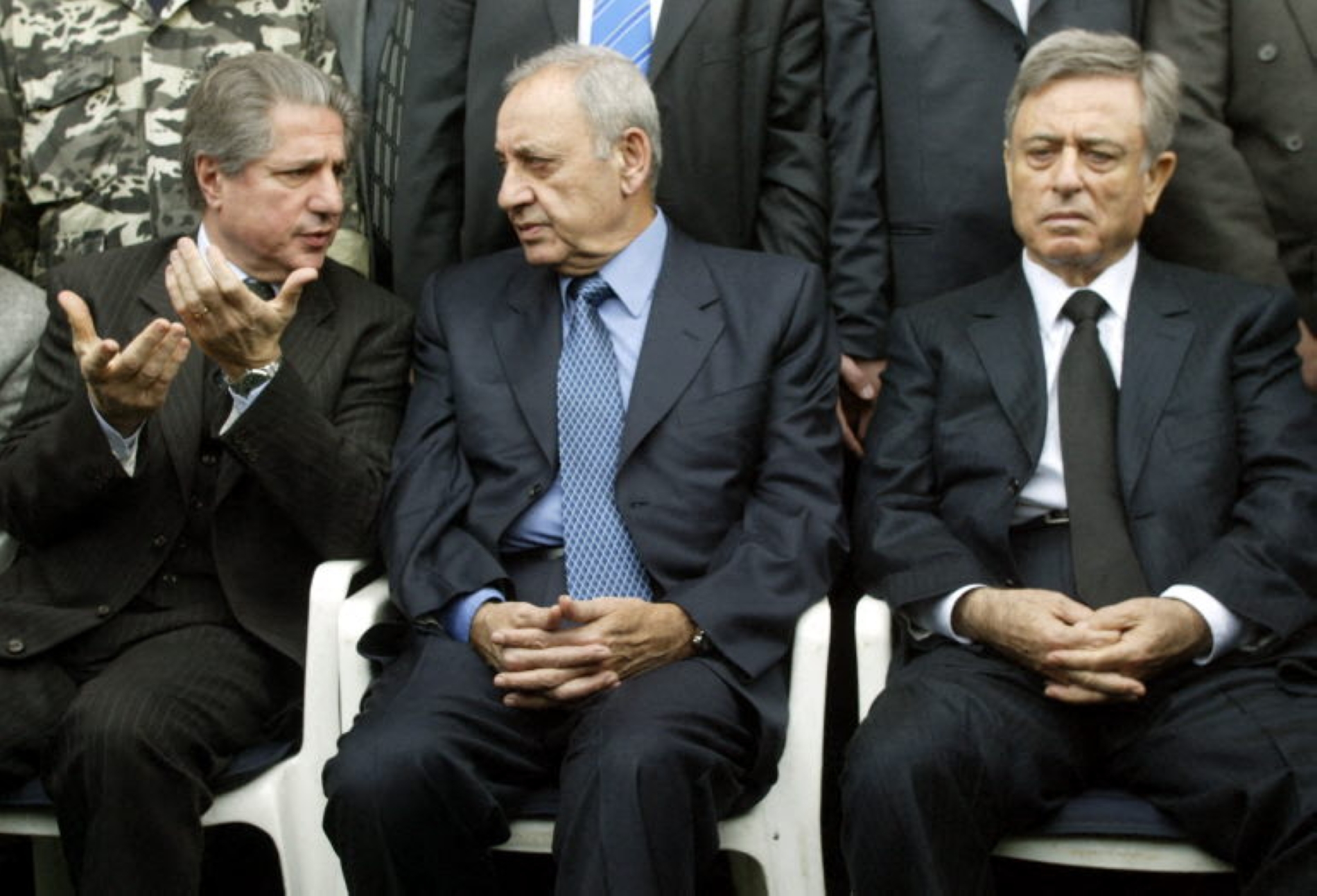
Syrian Vice President Abdul Halim Khaddam alongside Lebanese Parliament Speaker Nabih Berri and former Lebanese President Amin Gemayel at the funeral of former Lebanese Prime Minister Rafik Hariri in Beirut, February 16, 2005.

7. The mission of the Joint Verification Committees shall be terminated within 90 days following notification to that effect submitted by either party at any time it chooses after two years from the entry into force of this Agreement. Before their termination, alternative verification arrangements shall be established through the Joint Liaison Committee, which may at any time determine that such arrangements are no longer necessary.

f. The Security Arrangements Committee shall work to establish practical and rapid communications between the parties along the border, in order to prevent incidents through coordination among the forces deployed on the ground.

4. It is understood that the Lebanese Government may request the United Nations Security Council to take appropriate measures to deploy a UNIFIL unit in the Sidon area, in order to assist the Lebanese Government and the Lebanese Armed Forces in establishing their authority and providing the necessary protection in the areas of the Palestinian refugee camps for a period of 12 months. The unit stationed in the Sidon area shall have the right, at the request of the Lebanese Government and after notifying the Security Arrangements Committee, to send groups of its personnel to inspect and monitor the areas of the Palestinian refugee camps in the vicinity of Sidon and Tyre. The Lebanese authorities shall remain solely responsible for security and policing functions, and the Lebanese Government shall work to fully implement the provisions of this Annex in these areas.

5. Three months after the completion of the withdrawal of all Israeli forces from Lebanon, the Security Arrangements Committee shall conduct a comprehensive assessment of the suitability of the arrangements set out in this Annex, with a view to improving them.

6 — Withdrawal of Israeli Forces:

a. Within a period ranging from eight to twelve weeks from the entry into force of the Agreement, all Israeli forces shall have withdrawn from Lebanon, in accordance with Lebanon’s objective of the withdrawal of all foreign forces from Lebanon.

b. The Lebanese Armed Forces and the Israeli Defense Forces shall maintain continuous contact during the withdrawal and shall exchange all information through the Security Arrangements Committee. The Israeli Defense Forces shall also cooperate with the Lebanese Armed Forces during their withdrawal in order to facilitate the restoration and consolidation of the authority of the Lebanese Government as the Israeli armed forces carry out their withdrawal.

After the reading of the draft agreement was completed, Dr. Elie Salem said:

“Let us be practical and objective. We are a country that has been occupied by Israel and we want to get it out. We are not happy about paying the price, but we are compelled to pay it. I believe that, given the efforts we have made, this is the lowest price we can pay under the present circumstances in order to liberate Lebanon from this presence. At the same time, what matters to you is that throughout this process we have benefited from the Syrian card, and at all times we have made every effort to benefit from you in order to reduce the Israeli conditions.

“The problem now is that there has to be a price that we will pay. Are we little children? There is a price we will pay. The price is like what we paid in the 1949 Armistice, when our army was almost in Palestine. Now the Israeli army is in Beit Meri, in Beirut, so we are paying a price. There is no way for us to get Israel out now except by paying this price, and this is the lowest price possible. It does not differ in kind or substance from the armistice agreements between Lebanon and Israel, Syria and Israel, Jordan and Israel, and Egypt and Israel.”

A lengthy discussion then took place. Later that same afternoon, President Hafez received the Lebanese delegation, and discussions were held concerning the agreement along the same lines as those discussed at the Foreign Ministry. The Lebanese minister was informed of our categorical rejection of the agreement.

It is useful in this context to note that on April 26, 1983, after we became convinced that an agreement between the parties negotiating in Beirut was likely to be reached, we informed the United States, the Soviet Union, Saudi Arabia, and Lebanon as follows:

“We have learned that there is a possibility of reaching a Lebanese-Israeli agreement that would impose gains in Israel’s favor. Any gains that such an agreement achieves for Israel will prolong the presence of our forces until those gains are eliminated.”

It should be noted that the National Salvation Front held a meeting on February 3, 1984, at the home of President Suleiman Frangieh in Zgharta. Khaddam had agreed with Mr. Walid Jumblatt to hold this meeting and to issue a statement, taking into consideration the limits that President Frangieh could accept.

Following the meeting, the Front issued the following statement, read by Mr. Rashid Karami:

  • The Front called for a comprehensive and inclusive ceasefire.
  • The Lebanese Army should be kept neutral and not drawn into the internal conflict, in order to preserve the mission of the military service and the unity of the armed forces.
  • The multinational force should be withdrawn from Lebanon, and neutral alternatives should be sought after the force had become a party to the fighting.
  • Support the steadfastness of the Lebanese National Resistance and return to the Geneva Conference, whose objective was the annulment of the May 17 Agreement, and work toward achieving an unconditional Israeli withdrawal.
  • Abolish all manifestations and practices of domination, including coercive measures, legislative decrees, and appointments.
  • Regard national dialogue as the only means of mobilizing the country’s resources, liberating the territory, and establishing a reform program, and call for the resumption of dialogue on the basic principles of the Geneva Conference.

On February 9, the Front held a series of meetings in Damascus. President Hafez also received its members, Suleiman Frangieh, Rashid Karami, and Walid Jumblatt, emphasizing the importance of the Front’s continued existence, cohesion, and unity, particularly since it had become part of Lebanese political life.

The meeting addressed the fundamental issues, including the formation of a government and the resignation of Amin Gemayel. There was complete agreement that no government should be formed before agreement had been reached on the political program.

The Front’s leadership agreed on the following:

  1. Insist on the annulment of the May 17 Agreement as a fundamental condition for entering into national dialogue.
  2. Work to stop the fighting and condemn the army’s operations in the southern suburbs and the Mountain.
  3. Withdraw the army to its barracks, hold accountable those responsible for the destruction of the southern suburbs and the Mountain, and establish a supreme committee to oversee the armed forces.

On February 10, at his (President Assad’s) request, I met with Mr. Suleiman Frangieh, who presented the following proposals to me:

  1. President Amin Gemayel would send a decision annulling the May 17 Agreement, signed by him. If President Hafez approved it, Gemayel would travel to Damascus before the National Dialogue Conference and meet with the President.
  2. He proposed a radial security plan, with the Baabda Presidential Palace as its center, from which security would be gradually extended outward at a rate of one kilometer per day.

I replied to Mr. Frangieh that the first matter required a decision by President Hafez.

It should also be noted that, during his meeting with President Hafez, in the presence of his fellow members of the leadership of the National Salvation Front, Mr. Frangieh had proposed that the May 17 Agreement be submitted to the National Dialogue Conference and put to a democratic vote. His proposal was rejected.

The following day, I presented Mr. Frangieh’s proposal to President Hafez. He approved it, and I contacted Major General Ali Duba to dispatch Colonel Ghazi Kanaan to Mr. Frangieh and inform him of the President’s approval of his proposal.

Getty Images

Getty Images

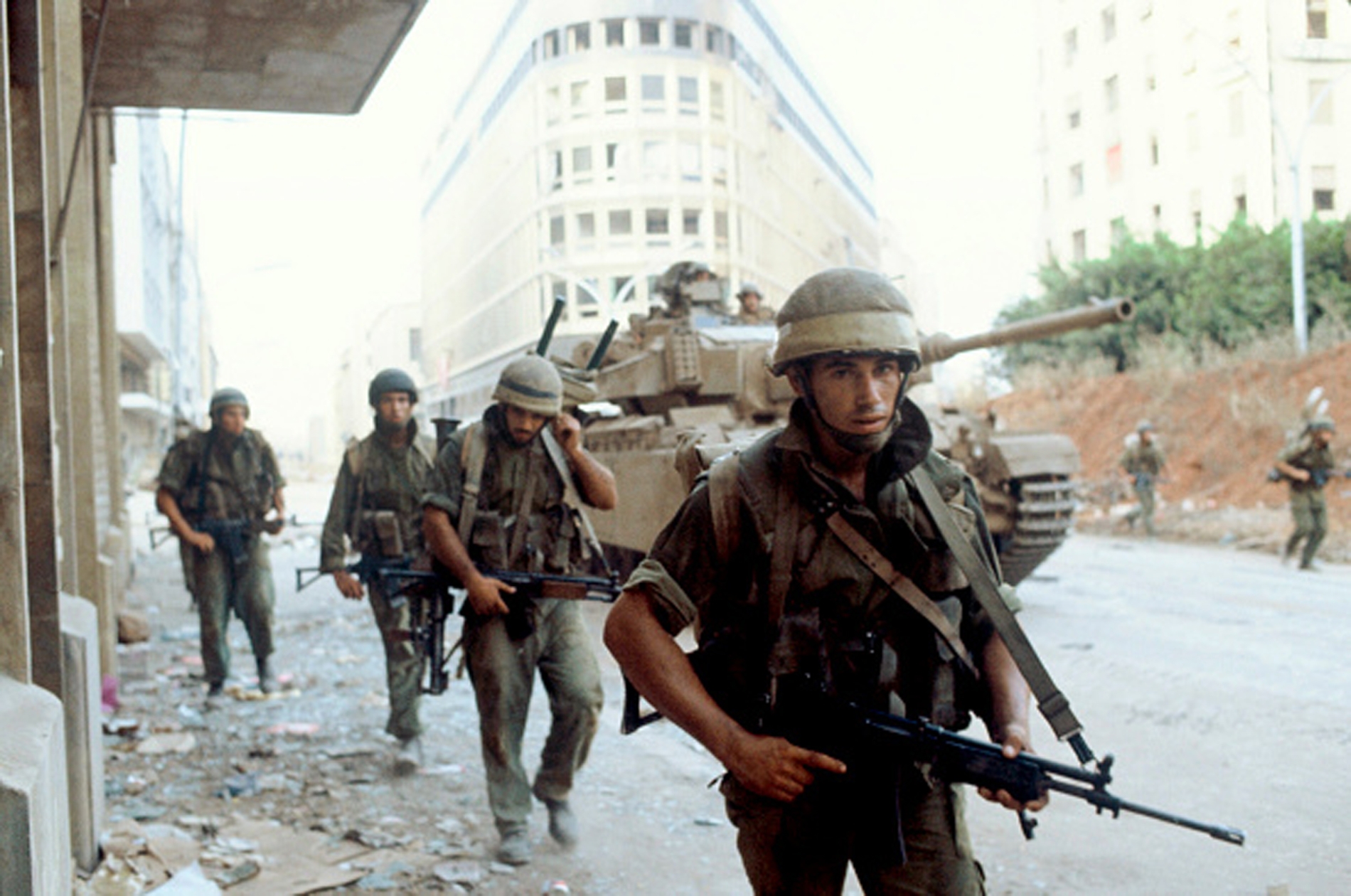
Israeli forces in West Beirut following the assassination of Bashir Gemayel, 1982.

On February 13, Major General Ali Duba contacted me and conveyed a new proposal from Mr. Frangieh. It read as follows:

“Amin Gemayel would make a private and unannounced visit to Damascus and hand President Hafez the document, signed by him, annulling the agreement. He would then go to Geneva, and during the meeting propose that the annulment be put to a vote, at which point he would be ready to announce it.”

I presented the proposal to President Hafez and told him that this was a new proposal and that it clearly involved a maneuver. Receiving Gemayel would serve to rescue him and undermine the opposition if there were no clear and prior position on the agreement, because he could come to Damascus without having anything in hand.

The President agreed with my assessment and asked me to convey the following response to Colonel Ghazi Kanaan:

“The President’s desire not to close the doors to reaching a formula that would achieve the objective—namely, the annulment of the agreement as a prelude to national dialogue—was the basis for his approval of the proposal that President Frangieh conveyed to Minister Khaddam.

However, the proposal conveyed by Colonel Ghazi is a new proposal.

The sensitivity of the situation and the danger of making a mistake as a result of ambiguity and lack of clarity, as well as the fear of maneuvering, make it essential to emphasize clarity and a clear position. Amin Gemayel’s coming to Damascus would greatly serve him and weaken the national opposition, particularly if he came forward with an unacceptable formula. In that case, we would have covered up all the mistakes of the Lebanese government and cornered the opposition—and this is what President Frangieh does not want.

What makes us cautious is that Amin Gemayel sent a written message with Minister Khaddam from Geneva, which Mr. Jean Obeid handed to him, in which he pledged to annul the agreement, and then went to Washington and did exactly the opposite.

Therefore, the first proposal that President Frangieh conveyed to Minister Khaddam in Damascus—namely, that a decision to annul the agreement, signed by Sheikh Amin Gemayel, be sent to the President—remains the basis.”
Colonel Ghazi conveyed this to Mr. Frangieh on February 15. Colonel Ghazi subsequently submitted the following report on his meeting in Zgharta:

“I met President Frangieh on February 15, 1984, at his home in Zgharta, and read to him the contents of the President’s message. He told me that he had met Gemayel at noon on February 14, 1984, at the Scout City, as had been arranged. The meeting lasted four hours.

Frangieh’s sole request during the meeting was that Amin Gemayel issue a decree annulling the agreement with Israel. However, Amin Gemayel replied to him literally that he regarded the agreement as a corpse placed in a refrigerator, and that it would emerge only as a corpse. He asked Frangieh for some time to consult the Americans and subsequently the Israelis. The discussions between the two ended at that point without agreement.

Frangieh also added that Gemayel was beholden to the United States and Israel. Gemayel had also told President Frangieh that he feared for his life if he took such a step. Nevertheless, he asked for time to give President Frangieh an answer, although Frangieh had no hope of a positive response.

In the end, President Frangieh added that the aforementioned man was not his own decision-maker, and that if he wanted to sit down with his wife, he would consult her first. ‘This is not a man.’ He expressed his disappointment in him and considered the matter closed.

It became clear that the two proposals put forward by President Frangieh had not been made in consultation with Gemayel. Rather, Frangieh had been hoping that he would be able to persuade him, but he failed.”

On February 24, 1984, I received Mr. Jean Obeid and confirmed the following to him:

  1. The annulment of the agreement and the adoption of the necessary legal measures must precede the national dialogue conference.
  2. The annulment of the agreement does not mean abandoning political reforms, nor does it mean that Syria would pressure the national forces to relinquish their demands.
Facebook
Twitter
LinkedIn
WhatsApp