Khaddam: Maher al-Assad Deceived Rafik Hariri Before His Assassination… So I Asked Him to Leave Lebanon

publisher: AL MAJALLA

AUTHOR: ابراهيم حميدي

Publishing date: 2025-02-14

Facebook
Twitter
LinkedIn
WhatsApp

The Syrian Vice President Asked the Lebanese Prime Minister to Leave… He Said, “I Have Elections,” and Khaddam Replied, “Your Life Is More Important.”

المجلة


The late Syrian Vice President Abdel Halim Khaddam says in his memoirs that after former Lebanese Prime Minister Rafik Hariri declined to form a government and left Lebanon, a political and media campaign was launched against him by allies of the Syrian regime, as well as by the Syrian and Lebanese security services. “The more intense the campaign became, the more popular Hariri grew, and the closer he became to Walid Jumblatt and the Christian parties represented in the Qurnet Shehwan Gathering. The man was accused of conspiring with the Americans and with Israel. One of the important events that took place in early October 2004 was the attempted assassination of Lebanese politician Marwan Hamadeh, an ally of Walid Jumblatt. It was a warning directed at all opponents of President Émile Lahoud in Lebanon.”

The day after the assassination attempt, Khaddam called Brigadier General Rustum Ghazaleh and told him that he was coming to Beirut to visit Marwan Hamadeh.

Khaddam adds: “He apologized, telling me that he was in his village in Hauran. I then called Walid Jumblatt’s office in Damascus and asked them to inform Walid Bey of the time of my arrival at the American University Hospital in Beirut. When I arrived at the appointed time, Mr. Walid received me, and we entered the hospital. It was impossible to see Marwan Hamadeh because he was in the operating room. Present alongside Walid Jumblatt were senior members of the Progressive Socialist Party, as well as Mr. Gebran Tueni, Marwan Hamadeh’s nephew. I expressed to them my deep regret over what had happened to my friend Marwan Hamadeh, with whom I had a close friendship.”

A Verbal Message from Khaddam to Hariri

According to his memoirs, after President Rafik Hariri declined to form his government, Khaddam stopped discussing Lebanon. “I confined myself to following developments through the information I received or through the media. Bashar al-Assad was mishandling the situation in Lebanon.”

He continues: “In mid-January 2005, we had a meeting of the Regional Command at the Presidential Palace, and the agenda concerned organizational matters within the party. The President [Bashar al-Assad] told us: ‘There is an American-French conspiracy against Syria, and Rafik Hariri is involved in it.’

“I was surprised, as were the other members of the leadership, by this serious statement. Two days later, former Lebanese Defense Minister Mohsen Dalloul visited me, and I entrusted him with a verbal message for Prime Minister Hariri. The message was that his situation was complicated and that I advised him to leave Lebanon immediately.”

Maher al-Assad Attempts to Mediate

On February 8, 2005, Khaddam went to Lebanon for medical examinations at the American University Hospital, then went to Rafik Hariri’s home at his invitation for lunch.

“The man was worried and asked me about the message that Mohsen Dalloul had conveyed to him. I explained the situation to him and advised him to leave immediately.

“He replied: ‘I have elections… How can I leave the people and go?’

“I answered: ‘Your life is more important than the people, and your family is more important than the elections.’

“He asked me about Maher al-Assad’s role in what was happening.

“I replied: ‘He has no political role. He is subordinate to his brother, so why are you asking?’”
أ.ف.ب

AFP

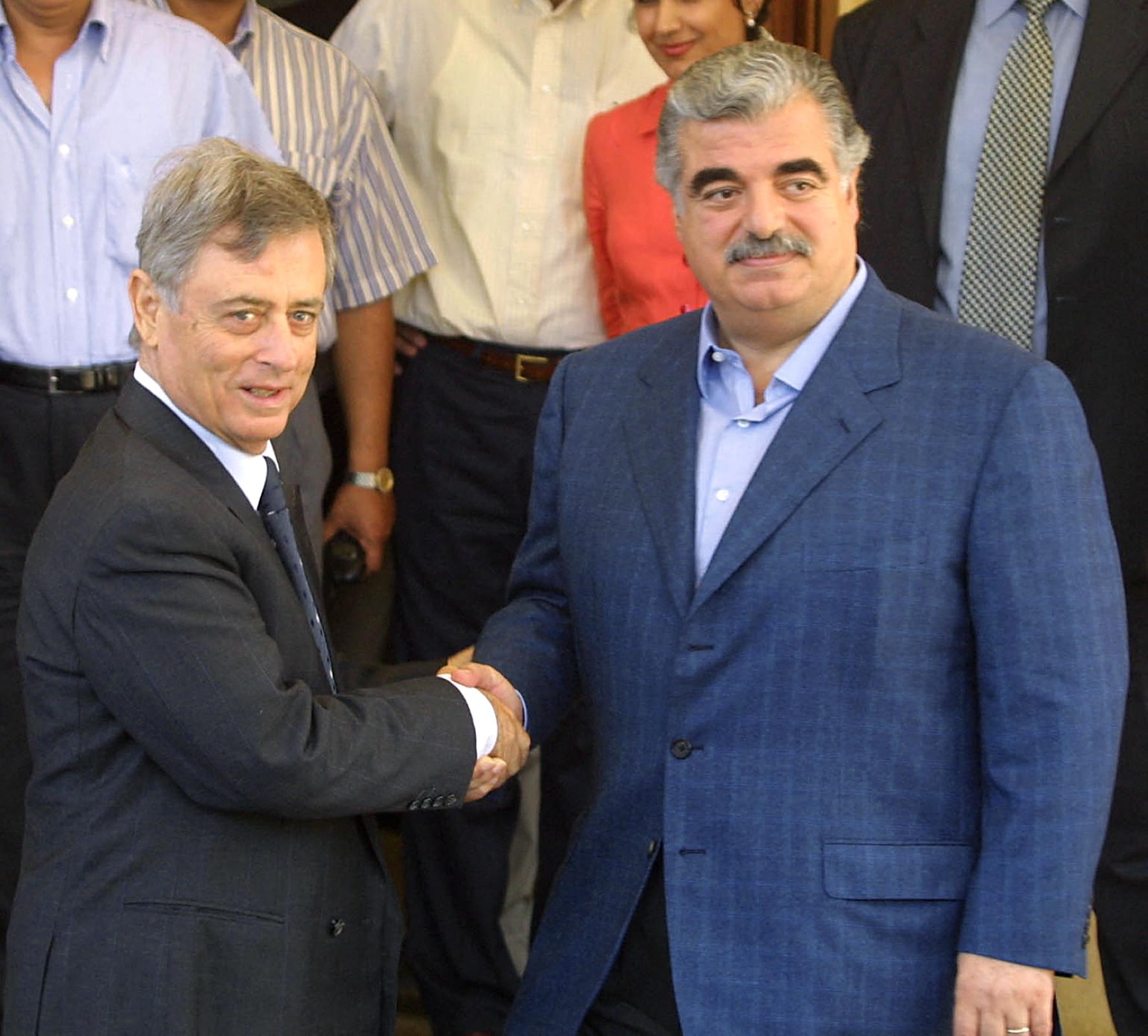
Former Lebanese Prime Minister Rafik Hariri and former Syrian Vice President Abdel Halim Khaddam before their meeting in Beirut on June 4, 2001.

He replied: “Aouni al-Kaaki, the owner of Al-Sharq newspaper, sent someone to me to tell me that Maher al-Assad was keen to establish relations with me and was prepared to resolve the problems existing between me [Hariri] and Bashar al-Assad. He considered me a loyal friend of Syria.”

I commented on the message: “In my view, you should be careful and leave Lebanon.”

I asked him about the way the Lebanese security services were dealing with him.

He said: “I had fifty security guards, but they withdrew them and left me with only six.”

The Killing of Rafik Hariri

Contact between Khaddam and Bashar al-Assad had been cut off since late October 2004. “Communications took place through his chief of staff, Muhammad Daaboul (Abu Salim), and sometimes through written messages.”

Khaddam continues: “On the day of the assassination of President Rafik Hariri, February 14, 2005, we were in a meeting of the Regional Command in Damascus. Afterwards, I went into Dr. Ahmad Dirgham’s office, where the television was on. The breaking news came as a shock: a massive explosion had occurred in Beirut near the British Bank.

“It was subsequently reported that the explosion had targeted the convoy of President Rafik Hariri and that he had been killed along with his bodyguards and a number of Lebanese citizens.

“I returned home, and there was deep grief among all members of my family. I called Abu Salim Daaboul (Muhammad Daaboul, Assad’s chief of staff) and asked him to inform the President that I would be leaving for Beirut the following day to offer my condolences to the family of the late Rafik Hariri.

“Minutes later, Abu Salim told me: ‘If you want to go, go in your personal capacity, because the President has already offered his condolences to President Lahoud.’

“I told him: ‘It never occurred to me to go in any capacity other than my personal one.’

“Abu Salim asked me: ‘Will you make a statement to the press?’

“I replied that I would not. I then called the Hariri family home and spoke with his son Saad, offering my condolences and informing him that I would be coming to Beirut the following day.”

أ.ف.ب

AFP

The destruction left by the explosion at the site of Rafik Hariri’s assassination, Beirut, February 14, 2005.

The following day, Khaddam traveled to the Lebanese capital, Beirut, accompanied by his wife and his two sons, Jamal and Jihad.

“We went directly to Hariri’s home, where a huge crowd had gathered at the entrance. I entered the condolence hall and stayed for some time, then met with President Hariri’s sons in the presence of Mr. Fouad Siniora. After returning to Damascus, I called Abu Salim Daaboul and informed him that I had returned and that I would go back to Beirut the following day to attend the funeral of President Rafik Hariri.

“He again stressed that I should attend in my personal capacity, and I repeated that I was not going to attend in any capacity other than my personal one.”

Khaddam adds: “Unfortunately, the Syrian regime decided to boycott the funeral and the condolence gathering, which further fueled accusations that the Syrian regime was responsible for the killing of Rafik Hariri. The official Syrian newspapers headlined their front pages: ‘Major Explosion in Beirut,’ without mentioning Hariri. The report stated: ‘A major explosion occurred yesterday in the Lebanese capital, killing a number of Lebanese citizens, among them Mr. Rafik Hariri, former Prime Minister of Lebanon.’”

Syria Will Not Rise Except Through Democracy

On February 27, Bashar received Khaddam after a four-month break in contact.

“After exchanging reproaches, he said: ‘Let us talk politics and put the past behind us.’

“I spoke with him about the situation in Iraq and relations with the United States, then the conversation turned to the domestic situation in Syria.

“I told him: ‘The domestic situation is bad and worrying, and political and economic reforms must be carried out.’

“He said: ‘Some changes can be made, though not in the cabinet, because it has only been three months since it was formed. But some directors with a bad reputation can be replaced.’

“I replied: ‘Removing these people is good, but it does not solve the problem. Political measures must be taken, including announcing the formation of a committee to draft a political parties law and another committee to review the media law. Frankly, Syria’s problem and crisis are the absence of democracy. This has made Syria the most backward country in the Arab world, and Syria cannot rise except through democracy.’”

Assad Worried About the International Investigation Commission and the Businessmen

Bashar asked me: “Wouldn’t the political parties law require a conference? Don’t we need a conference to amend the Constitution?”

I replied: “The previous Regional Congress already adopted that direction.”

He asked me: “Does the Regional Command agree?”

I replied: “Unanimously. As for amending the Constitution, there is no need for that now because the current Constitution does not prohibit political parties. If you mean Article 8 of the Constitution—which states that the Baath Party is the leader of the state and society—the circumstances in which it was established are different from those of today, because of the weakness of the party.”

He asked me: “What guarantees are there that the businessmen will not come to power?”

I replied: “That would happen only if some party members and security agencies helped them.”

The President said that he would convene a meeting of the Regional Command to discuss the political parties law, and then turned to the ongoing investigation into Hariri’s killing.

I told him that the investigators’ report would be bad, and that the international commission’s report would hold Lebanon and Syria responsible for the assassination of President Rafik Hariri.

He asked me: “How?”

أ ف ب

AFP

Bashar al-Assad throws sand onto the coffin of his father, Hafez al-Assad, with Abdel Halim Khaddam beside him.

So I replied: “As I expect, they will say that the bombing was not the work of a group or an individual because the amount of explosives, estimated at about one and a half tons, was of a highly explosive type not used in Lebanon. The explosion also occurred at ground level.”

I continued: “I want to go back a little. Before I traveled to France, I met with you and asked you about extending General Emile Lahoud’s term. You told me that this was out of the question because it was rejected by Lebanon, the Arab world, and the international community. I told you at the time that if the extension took place, you would not be able to bear the consequences that would result from it. After I returned from France, I met with you again, and you will remember what I told you: that the extension had placed Syria at the center of the danger zone.

“You asked me about possible solutions, and I suggested that you engage in dialogue with the Christian side under the leadership of the Patriarch. You agreed to that, but what happened to those proposals?”

Ghazale: “If Hariri does not submit, I will kill him”

Khaddam continued speaking to Bashar: “I summoned Prime Minister Hariri and informed him of your support for him to form the government. A few days later, obstacles arose and he withdrew his acceptance of the task. Rustum Ghazale deserves to have his head cut off because he played a role in complicating matters. His role resulted in something close to a popular consensus in Lebanon against Syrian policy, not only among Christians but among Muslims as well.

“I reminded him of Rustum Ghazale’s threats against Rafiq Hariri. He used to say publicly: ‘If Hariri does not submit to us, I will kill him.’

“I asked him: Why do you keep this man? He has harmed Syria, imposed protection payments, and taken $35 million from Al-Madina Bank.

“He replied—and I was surprised by his answer—saying: ‘I know he is a thief. He has built markets in his village and a large palace.’

“I asked him: Why are you silent about him?

“He replied: ‘The responsibility lies with Ghazi Kanaan. He was the one who recommended him.’

“I said to him: ‘Ghazi made a mistake, but should the mistake continue? You call him a thief, and you are Commander-in-Chief of the Army and President of the state. You are the decision-maker and you know all this information. Why does he remain in Lebanon, and why is he not held accountable?’

“He replied that he would look into the matter, but he did not.”

Withdrawal of Syrian forces from Lebanon

The conversation between Bashar and Khaddam then turned to the withdrawal of Syrian forces from Lebanon in implementation of UN Security Council Resolution 1559. Assad said: “Our commitment to the Taif Agreement is clear, and we will implement the Security Council resolution. We will not confront the international community, and we will withdraw from Lebanon.”

I responded: “I hope the withdrawal will be complete. More than thirty years of our presence in Lebanon is enough. We must leave.”

Khaddam adds: “At this point, the president confirmed that the withdrawal would be to our territory and that we would deploy our forces to protect the nearby border area around Deir al-Ashayir, and that we would withdraw all security personnel.” (The complete withdrawal took place in April 2005.)

Returning to what Khaddam had proposed to Assad after his return from France, he replied: “I assigned Walid al-Muallem—this was before he was appointed foreign minister—to conduct dialogue with Lebanese figures.”

I replied: “Do you think he was capable of carrying such a burden?”

He answered: “I met with Mr. Hassan Nasrallah, just as I met with Nabih Berri, and I asked both of them to conduct the dialogue.”

أ.ف.ب

AFP

Lebanese newspapers mourn Rafiq Hariri.

Resignation

Before the Ba’ath Party’s National Congress was held that summer, Khaddam met with Assad and told him:

“There is something I thought I should inform you about so that you will not be surprised regarding my resignation from my party and official positions. I have spent more than forty years in government positions and thirty-five years as a member of the party. I have decided to resign and devote myself to writing.

“He was not surprised by what I said, because I had repeatedly spoken at meetings of the Regional Command and to a number of party members about my desire to resign. He responded to what I said by remarking: ‘You have a great deal of experience.’

“I replied: ‘I am here in the country.’

“He then asked me to persuade a number of comrades not to seek party positions again at the congress. All of them were members of the old guard: Assistant Regional Secretary Abdullah al-Ahmar; Vice President Zuhair Masharqa; former Speaker of Parliament Abdul Qadir Qaddura; and Defense Minister and Deputy Commander-in-Chief Mustafa Tlass. I promised to speak with them and try to persuade them. Indeed, I first spoke with Mr. Abdullah al-Ahmar, who was easily persuaded. General Mustafa also responded quickly when I spoke with him. As for Mr. Zuhair Masharqa and Abdul Qadir Qaddura, they were obstinate, and their position was that they had not declined to run again because they did not want the president to interpret their refusal as a failure to cooperate with him.”

Khaddam adds:

“At the next meeting of the Political Committee, I decided to speak frankly to everyone about the concerns on my mind. I received a message urging me to remain silent from Bashar’s brother-in-law, Major General Assef Shawkat. The message was delivered by my friend Ahmad Issa, who had been secretary of the Tartus branch of the party and ambassador to Morocco and then Tunisia. He said to me: ‘Please, Abu Jamal, you know how much I love and respect you and your opinion, but you cannot withstand the harm that will be inflicted upon you.’

“I replied: ‘Thank you. But no one can prevent me from expressing my views.’”

Khaddam continues:

“In the evening, the Political Committee began its proceedings, and, according to tradition, it was chaired by Foreign Minister Farouk al-Sharaa. I was the first to speak, and I said:

‘After sixty years spent in political work, forty-one years in positions of power, and thirty-five years in the leadership of the party, I have decided to relinquish all my positions in the party and the state. This does not mean abandoning political and national work. I was keen to participate in this congress, the last party congress in which I will take part, in order to convey my vision and views, hoping that this would help the congress draw conclusions that would benefit the nation and the party.’

“Indeed, I resigned, then went to Paris in 2005 and announced my break with the regime.”

Facebook
Twitter
LinkedIn
WhatsApp