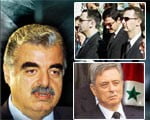
“The Lebanese details” are heavy with their intertwined complexities. At first glance, they appear political, only for their sectarian roots to quickly emerge, eventually becoming personal, reinforced by family, clan, or by the “keeper of the trust.”
In closed-door meetings, Syrian Vice President Abdul Halim Khaddam often complains about these “details,” which in most cases seem almost to encapsulate Lebanese political life. They threaten to drown anyone charged with dealing with them in a whirlpool of “piecemeal” calculations, minutiae, sensitivities, grudges, gossip, and the biographies of the players and their worthy descendants.
Even an issue as serious as United Nations Security Council Resolution 425, which called for the immediate and unconditional withdrawal of Israeli occupation forces from the south, can be transformed—in the marketplace of perpetual bidding and open-ended bargaining—into a demand of one sect, one group, or one particular party, as though what remains of the homeland were “whole and intact.”
Yesterday, on the sidelines of his evening visit to Beirut, the Syrian vice president touched upon a number of these “details” in his brief but richly suggestive remarks. As a statesman, he emphasized ways of addressing the problem for those “who genuinely want to treat it and heal it, rather than amuse themselves by exploiting the wounded man’s depletion for the sake of appearing to be the physician and promoting the myth of his blessed healing hand.”
Abdul Halim Khaddam said, in essence, from the heart of the presidential headquarters, that the “institution” is the source of authority and the natural framework for dialogue and discussion, whether these end in agreement or disagreement. Issues, he said, are raised in the Council of Ministers and resolved there—not outside it.
Khaddam also said, in essence, that individuals acquire their importance, or develop and embody that importance, within the institution; they grow through it, not at its expense.
While acknowledging the roles of individuals—the officials—Khaddam used that acknowledgment to affirm a principle that Lebanese people, particularly those who hold roles, positions, and influence, almost seem to overlook: that governing the Taif Republic is an explicit partnership between those known as the “traditionalists” and those who describe themselves as the “renewalists.”
To put it more plainly: government is a partnership between the politicians of the prewar era and the politicians who swept onto the political stage during the war, propelled by the waves generated by uprisings born of grievance, deprivation, fear, and the desire to avenge wounded dignity.
It is almost as though the accepted rule, until further notice, is: an “emir” from outside the militias and a “minister” from within them.
The presidency belongs to the traditionalists, heirs to the first generation of politicians of the “Republic of Independence,” but it is not absolute. It is subject to an “institution” whose construction—and then whose decisions—is shared with the “renewalists.”
As for sectarianism, neither the traditionalist nor the renewalist has any advantage over the other. Indeed, perhaps the “traditionalists,” by virtue of memories and practices extending back to the era of elections, electoral lists, and regions whose inhabitants have multiple religious and sectarian affiliations, are less forthright in declaring their “sectarianism,” and perhaps they have less need for it to affirm their “standing” and representative credentials.
Is it not a striking paradox that the Syrian vice president should come to Beirut and, among the burdensome tasks weighing on him, seek to reconcile officials who are among the “builders” of the Second Republic, repair the constitutional institutions, and urge them to return to those institutions and revive them through their “dialogue” over their “details,” which are rarely entertaining?!
And when does all this happen?!
…While U.S. Secretary of State James Baker begins his seventh tour of the region, in preparation for an invitation to a “peace conference” whose task is to formulate an acceptable “settlement” to the Arab-Israeli conflict;
…While the Israelis confront their distinguished “guest” with a united front, despite the multiplicity of their political and religious parties and currents, and use that very diversity as an additional tool of pressure and blackmail, with some of them pelting him with “tomatoes.” Meanwhile, the “reasonable” among them volunteer to conceal their disagreements or downplay them in order to preserve the thread of communication; otherwise, blackmail would become impossible;
…And while Syria is making intensive efforts to achieve a unified, common, or coordinated Arab position, based on a minimum level of solidarity, and to prevent Arab divisions from being exploited to perpetuate an age of defeat or to justify the surrender of some of the weary and those perhaps prepared for a separate peace—or something even worse, which would sacrifice Palestine without providing protection or guarantees to any other Arab country. Everyone is threatened, and the danger is imminent.
“Through constant discussion, based on our common interests, we arrive at common conclusions.”
Abdul Halim Khaddam began his remarks with these words upon arriving in Beirut yesterday evening, on the eve of the “imperial journey” to New York.
But the problem lies in the “identity” of the Lebanese interlocutor representing the Syrian partner.
This is precisely the problem that was supposedly addressed by assembling the three-headed delegation to the United Nations, through this ingenious—and at the same time extraordinary—arrangement.
An institution that is absent at home cannot simply be conjured into existence and then used abroad to demonstrate adherence to the age of democracy and governance through institutions.
The justifications offered for the three presidents traveling together only underscore the weakness of the existing institutions, if not their disappearance altogether. The world does not need a joint delegation to believe that Lebanon has been cured of its chronic sectarian disease.
In the absence of the “institution,” the dialogue will remain dysfunctional.
And the “state” in Syria will continue to search in Lebanon for someone who can genuinely engage with it, whether agreeing or disagreeing on the basis of interests and policy—not mood, desire, or an entrenched spirit of hostility.
Until that day comes, “the Lebanese details” will continue to weigh heavily on whoever is burdened with them, consuming his time and dissipating his efforts on matters that lead nowhere, only for him then to be accused of interfering in the internal affairs of this peculiar republic that has no “inside” at all… absolutely none!