Abdul Halim Khaddam: How I First Came to Know Bashar al-Assad… and How He Persuaded His Father to “Elect” Lahoud

publisher: AL MAJALLA

AUTHOR: ابراهيم حميدي

Publishing date: 2025-02-12

Facebook
Twitter
LinkedIn
WhatsApp

المجلة


On the 20th anniversary of the assassination of Lebanese Prime Minister Rafik Hariri, Al Majalla is publishing installments from the memoirs of former Syrian Vice President Abdul Halim Khaddam, which will soon be released by Rof Publishing House, affiliated with the Saudi Research and Media Group (SRMG), edited and presented by Ibrahim Hamidi.

London — In his memoirs, the late Syrian Vice President Abdul Halim Khaddam recounts details of his first meeting with former Syrian President Bashar al-Assad. He first met Bashar in Qardaha on the occasion of the death of his brother Basil in January 1994. Khaddam had first met Basil two years earlier, following the death of Khaddam’s grandmother.

“I had no interaction with President Hafez al-Assad’s sons or the sons of other officials because of the age difference. However, there were friendly relations and a friendship between Bashar and my sons Jamal, Jihad, and Bassim.”

Khaddam says:

“While we were in Qardaha, I learned that President Hafez’s family—his wife Anisa and her brother Mohammed Makhlouf—had met and decided to end Bashar al-Assad’s studies in London so that he could take the place of his late brother, whom Hafez al-Assad had been preparing to succeed him since the late 1980s.

“Indeed, Bashar began his activities and was sent to a military training course. After graduating, he began playing an active role in matters relating to the army and certain government affairs. His office—which had been Basil’s own office near Dummar—became a destination for ministers and those seeking ministerial positions, as well as for people aspiring to party or government posts.”

Entering the Lebanese File

Khaddam delves into the Lebanese dossier, which he was responsible for, particularly on the eve of the election of President Emile Lahoud. The election sparked a political storm in Lebanon because some of Syria’s most prominent traditional allies—such as Rafik Hariri, Nabih Berri, and Walid Jumblatt—opposed it.

Khaddam recounts:

“Lebanese parliamentarian and minister Suleiman Franjieh established close relations with Bashar, just as he had with his brother Basil. Prince Talal Arslan and Michel Samaha did likewise. They persuaded him to adopt their policy in Lebanon against the government of President Rafik Hariri, who had been in power since October 1992.”

Franjieh also opened a channel between Bashar and Lebanese Army Commander General Emile Lahoud. “Through him, the younger Assad became immersed in the regional situation and began intervening in Lebanese affairs, bypassing the political committee charged with managing this file, at a time when Lebanon’s presidential election was approaching at the end of President Elias Hrawi’s term.”

According to Khaddam, Bashar succeeded in “convincing his father to support General Lahoud’s candidacy for the presidency to succeed President Hrawi in 1998,” despite opposition from most of Syria’s Lebanese allies, including Walid Jumblatt, Nabih Berri, and Rafik Hariri.

Khaddam says of Lahoud:

“He was nervous and emotional and was not qualified to head a country like Lebanon, particularly since he was removed from the political atmosphere and divisions in that country and lacked an understanding of the Lebanese character.”

Dispute Over Emile Lahoud

Khaddam continues:

“I discussed the issue of Emile Lahoud repeatedly with President Hafez and gave him all the reasons that compelled me to oppose Lahoud’s candidacy. But the elder Assad insisted on supporting him. Thus, Bashar succeeded in installing Lahoud as president at Baabda Palace beginning November 24, 1998.

“He assigned the head of the Syrian intelligence service in Lebanon, Major General Ghazi Kanaan, to exert pressure on Lebanese parliamentarians, even though Parliament Speaker Nabih Berri was one of Lahoud’s strongest opponents. Walid Jumblatt likewise continued to oppose him and did not respond to the Syrian request to support his candidacy.”

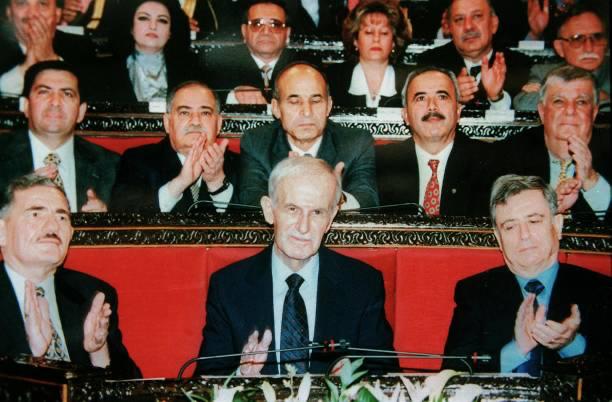
Former Syrian President Hafez al-Assad (center) receives applause from his Vice President Abdul Halim Khaddam (right) and Syrian parliamentarians on March 11, 1999, during the ceremony for his swearing-in for a fifth presidential term.

Request to Be Relieved of the Lebanese File

After Lahoud was elected and sworn in, Khaddam asked President Hafez al-Assad to relieve him of responsibility for the Lebanese file, “because my position on his election was well known, and therefore this would affect my relationship with the new Lebanese president.” The elder Assad agreed to his request and entrusted the Lebanese file to Bashar. “Thus, the political management of this complicated file came to an end and it fell into the hands of the Syrian security agencies.”

Khaddam adds:

“Until that point, there had been no meeting between Bashar and me, apart from our first meeting on the occasion of Basil’s death. Then General Ibrahim al-Safi (commander of the Syrian forces in Lebanon) and Izz al-Din Nasser (head of the Workers’ Federation) came to me and raised the issue of meeting with him. I delayed giving them my response. Then Major General Ghazi Kanaan came to me and pressed the same matter. A few days later, General al-Safi invited me, along with Izz al-Din Nasser and Major General Kanaan, to lunch at the corps headquarters in Lebanon, and I agreed to receive Bashar at my home in Damascus.”

He continues:

“Two days later, Bashar came to me. Ibrahim al-Safi, Izz al-Din Nasser, and Ghazi Kanaan were also present. The meeting lasted more than four hours. We discussed the domestic situation, the economic situation, and combating corruption within state institutions. Bashar was open and spoke at length about these issues. I came away with a positive impression, and I met with him several times afterward, before his father’s death.”

Assad and His Son “Had Their Minds in Their Ears”

In his memoirs, Khaddam recounts the beginnings of the deterioration in his relationship with Bashar al-Assad and describes the lunch they shared at Ghazi Kanaan’s home in Chtoura in Lebanon’s Bekaa Valley.

He says:

“Then came the year 2000, and I began hearing negative remarks attributed to Bashar about me, but I paid no attention to the matter. Toward the end of January, I was in Baniyas when Ghazi Kanaan came to me and said: ‘Why is there this atmosphere between you and the president’s family? They say that you criticize the president in your conversations and that you criticized him at one of the Regional Command meetings.’

“I replied: ‘The problem with President Hafez and his son is that they have their minds in their ears. I am in Damascus—why doesn’t President Hafez call me and ask me about it?’

“Major General Ghazi replied: ‘There are people passing on remarks in order to create friction between you and them. Therefore, I suggest that you accept my invitation to lunch at my home in Chtoura, and I will invite Bashar.’

“I said: ‘I have no objection.’”

Khaddam adds:

“Indeed, the meeting took place at the general’s home. Bashar and I sat together privately, and he asked me: ‘Why are you attacking my father, when it is well known that you are his partner in everything related to foreign policy?’

“I smiled and said to him: ‘The president should have asked the Assistant Regional Secretary of the Baath Party for the recording, which contained the full conversation. You should also have called Dr. Suleiman Qaddah (the Assistant Regional Secretary) and asked him about the matter.

“‘The matter, Doctor, happened as follows: Foreign Minister Farouk al-Sharaa presented a report on his meeting in Washington with Ehud Barak, President Bill Clinton, and Secretary of State Madeleine Albright’” (this took place during the Syrian-Israeli peace talks in Washington).

The report stated that Clinton was siding with Syria and that Barak had told Farouk that President Hafez al-Assad was the most important Arab president since Muawiya ibn Abi Sufyan.

Assad Criticizes Farouk al-Sharaa

Khaddam continues:

“After al-Sharaa finished speaking, I said to him: ‘Farouk, you have been working in the Foreign Ministry for nearly twenty years, and I find it astonishing that you say Clinton is on our side when he has given Israel—and you are negotiating with Barak—fifty F-16 aircraft. What indications are there that he is on our side? How can you say that Clinton is with us? And how can you repeat what Barak said about President Hafez—that he was the best president after Muawiya? Didn’t you realize that he was telling you what he thought would please you? He wanted to fool you. This is what I conveyed to Bashar.’

“He replied: ‘Farouk al-Sharaa is not an intelligent man.’

“At this point I said to him: ‘If that is the case, then why insist on keeping him?’ He fell silent and did not answer.”

The Death of Hafez al-Assad in 2000

After a date had been set for the Regional Congress of the Baath Party, Khaddam says he met at his home in Bloudan with Bashar al-Assad, Izz al-Din Nasser, General Ibrahim al-Safi, and Major General Ghazi Kanaan.

“We discussed the Regional Congress privately, and continued meeting regularly until the death of President Hafez on June 10, 2000.”

Khaddam then recounts his telephone conversation with President Hafez:

“It was customary for me to go to Baniyas on weekends, so I called the president on the morning of Wednesday, June 7, to ask his permission. We had a lengthy conversation over the phone about people’s health as they grow older. He said to me: ‘You alone knew how to take care of your health, at a time when I and the other comrades did not pay attention to ours. Ever since you were young, you have exercised, gone to the sea, and climbed up to Bloudan.’

“I replied: ‘Don’t you remember how often I advised you to rest and emphasized the need for a vacation? That was also what the doctors advised you after you overcame your heart attack in the 1980s. You carried out your duties as president of the republic while also performing the work of the heads of the security agencies. You placed the affairs of the state and its institutions on your shoulders, when you should have delegated some of your essential powers to your deputies and to the government.’

“He said: ‘That is true. I have carried burdens beyond my capacity.’

“The conversation lasted more than half an hour, and he asked me when I would return from Baniyas. I replied: ‘I will return Saturday morning.’

“He said: ‘When you arrive, call me.’”

Khaddam then turns to the death of Hafez al-Assad:

“I traveled that day to Baniyas and returned to Damascus on Saturday. When I arrived home, they told me that the presidential palace had asked for me. I assumed the request was for a meeting with the president. I called the palace, and they informed me that Dr. Bashar was waiting for me at his home. At that point, I realized that President Hafez might have died or might be clinically dead.

“I changed my clothes and immediately went to the president’s home. I saw a group of military officers gathered outside, and at that point I became certain that he had died. In the reception hall, I found the members of the leadership with Dr. Bashar and his brother-in-law Assef Shawkat. They were discussing how to announce the death.

“Defense Minister General Mustafa Tlass informed me that the Regional Command had decided to nominate Bashar al-Assad for the presidency of the republic, and had taken a second decision to amend the constitution, with the People’s Assembly scheduled to meet that evening to approve the amendment.

“I did not discuss the matter. The leadership had made its decision, and it would not have been appropriate to enter into discussions about it.”

General Tlass Wanted to Become Army Commander

Khaddam then recounts the details of Bashar’s appointment as Commander-in-Chief of the Army and Armed Forces on the eve of his assumption of the presidency, succeeding his father, who had just died.

“It was decided that the Regional Command would send two written letters to the People’s Assembly. The first was to amend the constitution regarding the minimum age for the president” (Bashar al-Assad was 34 at the time, while the constitution stipulated that a presidential candidate must be at least 40). “The second letter concerned Bashar’s nomination for the presidency.

“On the evening of the president’s death, June 10, 2000, I met with Dr. Bashar at his home and proposed that he be promoted to the rank of lieutenant general and appointed Commander-in-Chief of the Army and Armed Forces.

“He asked me: ‘Shouldn’t we seek General Mustafa [Tlass’s] opinion?’

“I replied: ‘We can inform him of the decision rather than ask him.’

“We then agreed to meet the following day in the presence of General Tlass. Dr. Bashar said to him: ‘Abu Jamal [Khaddam] has a proposal.’

“He asked me to explain the proposal to General Mustafa. I said that the situation required appointing a Commander-in-Chief of the Army and Armed Forces, and I proposed appointing Dr. Bashar so that he would have a legitimate official position within the state.

“Mustafa Tlass’s face turned pale and he fell silent. I told him: ‘It would be useful to proceed with this quickly.’

“Tlass replied: ‘I will ask the legal adviser at the Ministry of Defense to prepare the decree.’”

أ.ف.ب

The decree was delayed, so Izz al-Din Nasser contacted General Mustafa Tlass’s office manager and asked about the reason for the delay. He was told that General Tlass wanted Bashar to be promoted to the rank of general, rather than lieutenant general, because Tlass wanted to become Commander-in-Chief of the Army and Armed Forces himself.

“Our conviction was that Mustafa Tlass was not suitable for this position because of his particular character and conduct, in addition to the fact that he had long since lost what was required of a military commander. The second reason for rejecting Abu Firas’s proposal was that I had decided to support and assist Dr. Bashar, even if this came at the expense of the old comrades in the party, including ‘Abu Firas.’ We must not forget that Hafez al-Assad had built a system that placed Syrians before two choices: either accept the regime with all its flaws, or face civil war.”

An Arab Recommendation

Khaddam also recounts the details of his meeting with a “prominent Arab leader” who told him that he supported Bashar al-Assad’s presidency. He says:

“On June 13, 2000, we went to the village of Qardaha to attend President Assad’s funeral. After the burial ceremony and receiving condolences, I returned to my home in Baniyas. My office manager called me and told me that an Arab leader was in Damascus and wanted to meet me. He was among the most prominent Arab guests who had attended Hafez al-Assad’s funeral.

“I went to Damascus and arrived after midnight. At Tishreen Palace, I found the distinguished guest waiting for me. We spoke about President Hafez’s personality, and he held him in great affection. He then turned to the situation in Syria and said: ‘People are now in a state of mourning, but after a month or two the grief will subside and they may move against you. I hope, Abu Jamal, that you will stand by Dr. Bashar and cooperate with him for the good of the country.’

“He then added: ‘We have informed Rifaat al-Assad (the late president’s brother, who was exiled in Europe and had aspired to the presidency since 1984) that we support his nephew and will not accept anyone destabilizing Syria.’”
Facebook
Twitter
LinkedIn
WhatsApp