Abdul Halim Khaddam recounts the details of the “stormy meeting” between Assad and the Lebanese prime minister before the assassination of the Lebanese prime minister.

On the 20th anniversary of the assassination of Lebanese Prime Minister Rafik Hariri, Al Majalla is publishing excerpts from the memoirs of former Syrian Vice President Abdul Halim Khaddam, which will soon be released by Rof Publishing House, affiliated with the Saudi Research and Media Group (SRMG), edited and presented by Ibrahim Hamidi.
In this installment, Khaddam recounts details of the stormy meeting between Bashar al-Assad and Rafik Hariri:
After the referendum and Bashar al-Assad’s swearing-in before the People’s Assembly on July 17, 2000, the late Syrian Vice President Abdul Halim Khaddam met with Bashar and presented him with “a memorandum on issues of party and political reform.” Assad welcomed the ideas and suggested that they be discussed by the Regional Command.
Khaddam adds in his memoirs:
“I was keen, as part of my cooperation with him, to assist him and provide every possible effort, along with whatever experience I had in state affairs and their requirements. I presented studies on economic reform, as well as others on administrative, judicial, and educational reform. Despite everything I had been observing since the second year of his presidency, I maintained my positive approach toward him. It should be noted that he treated me with great affection and respect. I accompanied him on most of his foreign visits and the conferences he attended, and I worked to ensure the success of those visits. He also consulted me on all political issues, and I gave him the best I had because I believed that through this cooperation I was serving my country and protecting it from whatever harm might befall it.”
The Extension of Emile Lahoud’s Term
Khaddam says there were two issues on which he had a “deep disagreement” with Bashar al-Assad: “the first concerned relations with France, and the second concerned extending the term of Lebanese President Emile Lahoud.”
He says:
“This issue was occupying the Lebanese public, which was divided between an overwhelming majority opposed to the extension and a minority supporting it. In addition, there was widespread international opposition to the extension, reinforced by a meeting between U.S. President George W. Bush and French President Jacques Chirac in June 2004. The two presidents firmly reiterated their opposition to extending Lahoud’s term and condemned Syrian interference in Lebanese affairs.
“It was clear to me that any irrational position by the regime in Syria would cause major damage to the country. Therefore, in all my meetings with Dr. Bashar, I tried to convince him of the dangers of extending Lahoud’s term, particularly after the enormous pressure exerted by the Lebanese president on Prime Minister Mr. Rafik Hariri.
“Assad had summoned Hariri in July, as I recall, at 7:30 in the morning, in the presence of Major General Ghazi Kanaan, Brigadier General Rustom Ghazaleh, and Colonel Muhammad Khallouf. The harshness of the language used during that meeting caused Prime Minister Hariri’s blood pressure to rise and resulted in a nosebleed.”
Assad: “Whoever Opposes Me, I Will Break His Bones”
That morning, Khaddam had an appointment with Bashar al-Assad, who “was agitated and tense.” Khaddam told him what had taken place during his meeting with Hariri.
According to Khaddam’s account, Assad said:
“I had Rafik Hariri with me, and I spoke to him clearly and frankly, in the presence of the officers. I told him that he was not permitted to work toward bringing in a president other than Emile Lahoud. I am the one who chooses who governs Lebanon, and whoever opposes me, I will break his bones.”
AFP
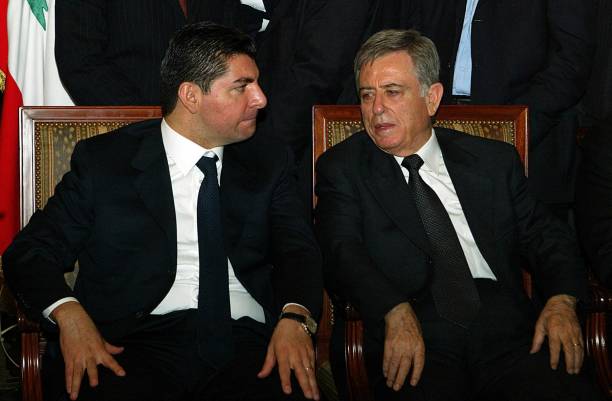
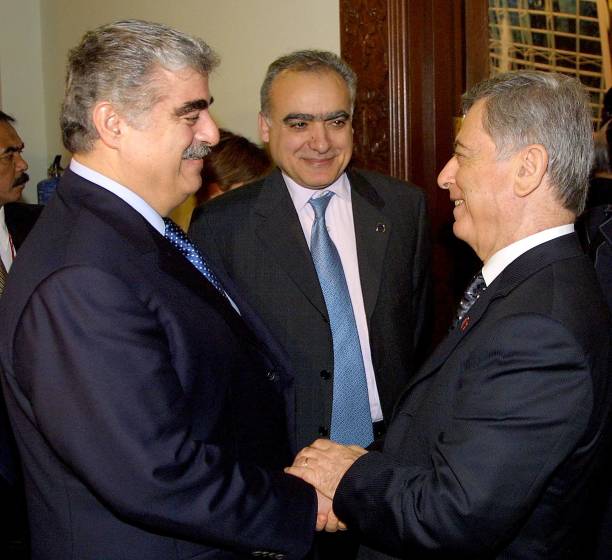
Former Lebanese Prime Minister Rafik Hariri and former Syrian Vice President Abdul Halim Khaddam before their meeting in Beirut on June 4, 2001.


Khaddam adds:
“The Spanish minister was surprised by this response. The following day, the Security Council met and adopted Resolution 1559, which included a call for Syria to withdraw its forces from Lebanon and refrain from interfering in its internal affairs. The resolution also called on Lebanon to hold presidential elections without foreign interference, affirmed Lebanon’s independence and sovereignty, and called for the disbanding of non-governmental armed groups. The resolution was adopted under Chapter VII of the United Nations Charter, and thus the regime in Syria came under the scrutiny of the Security Council.”
Khaddam asks:
“Why did Assad change his decision and move toward supporting the extension of General Lahoud’s term? And then why did he enlist Spain’s mediation, only to change his decision five hours later? Was this the result of pressure from people close to him, or was it connected to matters involving the security agencies in Lebanon that were partners in the Syrian security apparatus? Or was the matter simply the result of personal emotional reactions stemming from fear and hesitation?”
Khaddam returned from France on September 5, 2004, and the following day Bashar received him. He “told me about his meeting with U.S. Congressman Darrell Issa, who had expressed his willingness to make efforts to improve Syrian-American relations. He then spoke about his meeting with Martin Indyk, the former national security adviser to U.S. President Bill Clinton. Then he said:
‘We received information that the United States and France had agreed to remove Syria from Lebanon and that Rafik Hariri had played a major role in this agreement.’
“I replied: ‘I find that surprising. Is it conceivable that Hariri could have a role in determining the policy of the United States and France toward the Middle East? Hariri told me after you spoke with him that, although he was not convinced by the extension, he would agree to it and did not want to take a position that would lead to Syria’s defeat in Lebanon.’
“He said: ‘I asked the Foreign Minister to make visits to several European countries to explain our point of view and to ask the Spanish Foreign Minister for assistance.’
“I replied: ‘Spain cannot separate its policy from that of the European Union, and the Spanish ambassador to the United Nations was presiding over the Security Council when Resolution 1559 was adopted. I had advised against having al-Sharaa make this visit because Europe is in a state of heightened tension toward Syria.’”
Khaddam adds:
“We moved on to discussing the repercussions of Resolution 1559 and how to deal with it. I told him: ‘The proper course would be for President Emile Lahoud to resign and for a new president to be elected. The other solution, which would minimize the losses, would require making concessions, such as reconciliation with the Christian side and dialogue with the Patriarch, Mar Nasrallah Boutros Sfeir.
“‘I told him: You personally should take charge of the dialogue process.’
“He asked me: ‘How can there be dialogue with the Patriarch? The others can be invited.’
“I replied: ‘I suggest inviting Speaker Berri, President Hariri, Hassan Nasrallah (the former Secretary-General of Hezbollah), and Mr. Walid Jumblatt to Damascus. After reconciliation, you should authorize them to engage in dialogue with the Christian side, then form a national-unity government and establish an electoral law acceptable to everyone.’”
Khaddam continues:
“I left the meeting expecting Dr. Bashar to take effective steps toward reconciliation, but that did not happen.”
Hariri’s Last Visit to Damascus
On September 21, 2004, President Rafik Hariri visited Khaddam and, “after reviewing the stages of cooperation between him and the Syrian leadership, spoke about his agreement to the decision to amend the constitution despite not being convinced by it. He stressed that there was no possibility of cooperation between him and President Lahoud, and said that it was not in Syria’s interest for him to form the government in the coming period. He concluded by saying that he was the Muslim and Arab son of Sidon and could not take any step that would harm Syria or weaken its position in Lebanon.”
After Hariri finished speaking, Khaddam responded:
“I agree with you about not forming the Lebanese government.”
Khaddam told Hariri that he would present their discussion to Assad, and “the following day, the president received him for the last time.”
According to Khaddam, Assad assured Hariri of Syria’s concern for him and praised his cooperation with Syria, particularly his acceptance of the extension of President Lahoud’s term. “At this point, Hariri repeated what he had told me about his position toward Syria.”
Assad said:
“I will not accept anything anyone tells me about you, regardless of who it comes from. I will throw it into the wastebasket.”
The meeting ended with a promise that they would meet again before the end of 2004. “Hariri left the meeting reassured, and his words and expressions were different from what they had been before.”
Farouk al-Sharaa Accuses Hariri of Conspiring Against Syria
At the same time, however, the National Progressive Front in Syria held a meeting at which the Foreign Minister, Farouk al-Sharaa, gave a political briefing on the situation in the region and in Lebanon.
“ One of the members of the Front asked him whether Hariri would form the next government. He replied: ‘That is out of the question because he is conspiring against Syria with President Jacques Chirac, who is receiving money from Rafik Hariri.’”
According to Khaddam, most members of the Front were surprised by this response, particularly since President Assad had met with Hariri only a few days earlier.
“I called the president and asked him: ‘Did you give Farouk al-Sharaa instructions to say that Rafik Hariri would not form the government and that he was paying money to President Jacques Chirac? You know that these remarks will reach the French and make the situation even more complicated.’
“He replied: ‘I gave no such instructions. And who asked him to talk about Lebanon in the first place? What does he have to do with Lebanon? This man does not understand.’
“Then he asked me to call Hariri and tell him on his behalf: There is no prime minister in Lebanon other than Rafik Hariri, and anything he hears to the contrary is untrue.”

Khaddam adds:
“Indeed, I called President Hariri and conveyed President Bashar’s message to him. A long period passed without the government being formed, so I called Hariri to ask about the reasons for the delay in forming the cabinet. He replied: ‘Your people and Lahoud are putting obstacles in the way.’
“I asked him: ‘Did you inform Brigadier General Rustom Ghazaleh of what the president had said?’
“He replied: ‘I called him, and he told me, “We will not intervene and have nothing to do with the formation of the cabinet.”’
“I asked him: ‘Did you call President Berri?’
“He replied: ‘I was with him an hour ago, and he advised me to decline [the mandate].’
“At that point I told the man: ‘Arrange your travel and send a letter declining the mandate from the airport.’
“And indeed, he issued a statement announcing his decision to decline forming the government, ending it with the following words: ‘I entrust Lebanon and its people to God.’
“As though he sensed that his death was near.
“After I ended the call with him, I called Dr. Bashar and said to him: ‘The formation of the government in Lebanon has been delayed. Are there reasons for this?’
“The president replied: ‘I am going to wage a battle against the Americans, and I cannot fight it with Hariri.’
“At that point, I realized that the obstruction had been ordered by him and that Farouk al-Sharaa was aware of this decision.”