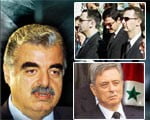
Bashir Rejects Any Appearance of Coordination Between the Israeli and Lebanese Armies… Sharon: The Americans Asked Us to Sell Tanks to the Lebanese Army
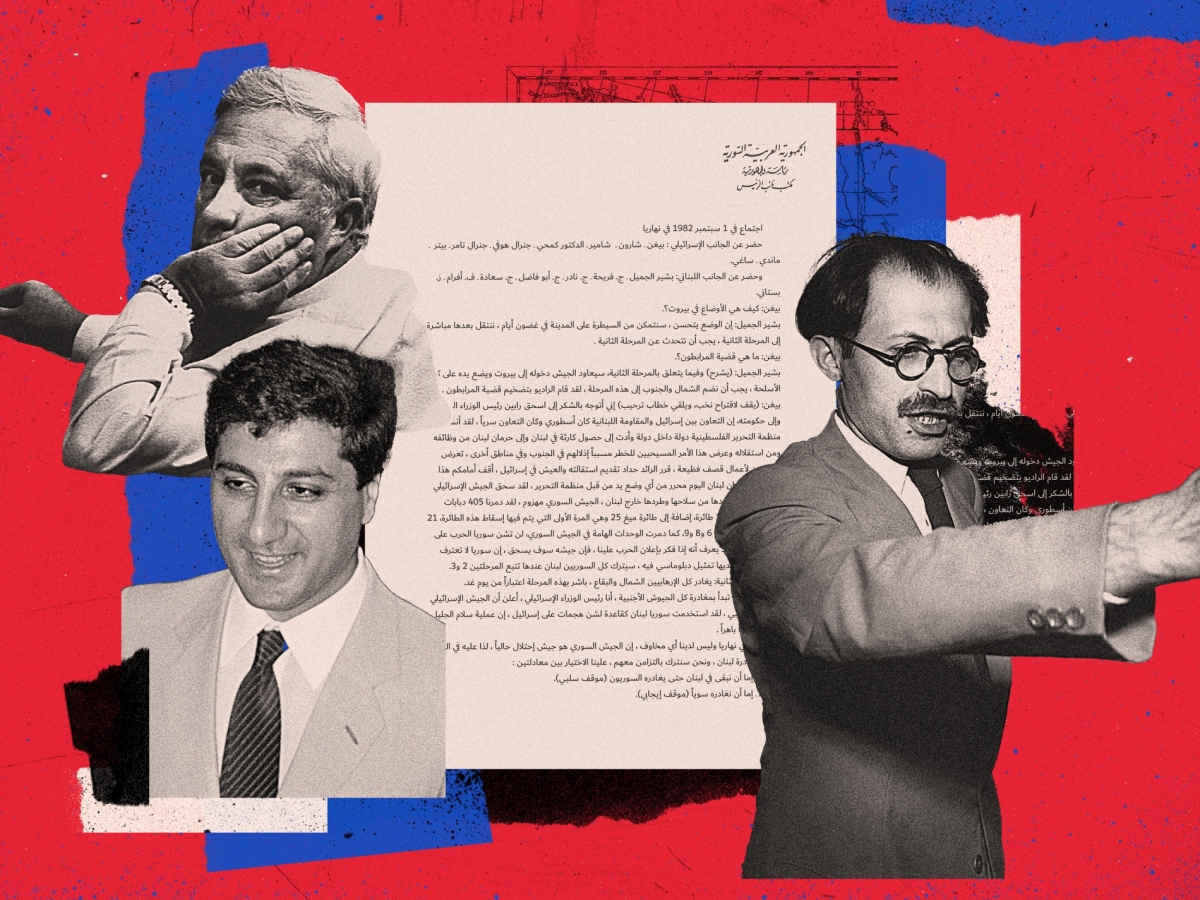
After the “stormy” meeting in Nahariya between Lebanese President Bashir Gemayel and Israeli Prime Minister Menachem Begin on September 1, 1982, a meeting was held between Gemayel and Israeli General Ariel Sharon in Beirut on September 12, 1982. The meeting ended at 2 a.m. on September 13, just one day before Gemayel was assassinated in Beirut. According to documents belonging to former Syrian Vice President Abdel Halim Khaddam, the meeting focused on relations between Israel and Lebanon.
Khaddam summarizes the meeting by saying that Sharon and Gemayel exchanged apologies over what had happened at the Nahariya meeting. Bashir said that he had not expected Prime Minister Begin to speak to him in that manner, as though he were a Syrian or Palestinian. This led him to refuse to receive any Israeli official after that date, fearing that this manner of addressing him would continue, which he considered incompatible with the long-standing relationship between the two sides.
For his part, Sharon, according to Khaddam, said that he had come to meet his interlocutor without anyone knowing—not even his personal aides. He thanked him for the invitation and said that the prime minister had been deeply upset because Bashir had never spoken about them (the Israelis) or referred to the efforts and sacrifices they had made in Lebanon. On the contrary, he had placed them alongside the other foreign forces that were supposed to leave Lebanese territory. This had also allowed the opposition in Israel to launch a harshly critical campaign against Begin, which could weaken him in the next elections because of the heavy losses Israel had suffered in Lebanon without receiving any gains in return.
Sharon pointed out that he had held 54 meetings with his interlocutor, U.S. envoy Philip Habib, and Lebanese intelligence chief Johnny Abdo, who had previously stated in press interviews that he had never met Sharon and that Sharon had met U.S. envoy Philip Habib at his home without him being present. Sharon said that he understood the Lebanese problem very well, stressing that Israel was helping the Christians only because they were a “small country,” like Israel, and that Israel expected nothing in return, just as it had helped the Kurds against Saddam Hussein.
Sharon confirmed that Begin liked Bashir Gemayel, but that President Camille Chamoun’s statement and Bashir’s position had hurt him deeply. Sharon said that his eye had been on the Baabda Palace when the military campaign began, and reminded his interlocutor that he had asked him for the addresses of members of the Lebanese parliament, but that Bashir had not taken the matter seriously. Sharon also criticized the practice of conducting official contacts with the Lebanese government through the Americans, calling for direct channels of communication to be opened.
They then turned to matters on the ground. Sharon asked his interlocutor for his opinion on every move he intended to make and whether they could proceed with it. Bashir initially opposed the Israeli army entering Beirut at that stage, but then agreed to their entering behind the Lebanese army on the grounds of ensuring that everything went smoothly, provided that the existence of coordination between the Israeli and Lebanese armies did not become public. He asked his interlocutor to coordinate on this matter with Hores, former President General Michel Aoun, and Israeli General Amir Drori.
Regarding relations with the United States, Bashir commented that Lebanon had suffered when the Americans did not understand it, and that Israel had helped remove this misunderstanding. The three parties therefore needed to discuss the future of their relationship. He welcomed Israeli attacks on the Syrian army and supported providing assistance to the Lebanese army in this regard. He also discussed the request to station an Israeli intelligence officer at Beirut airport, agreeing only to the placement of a technical officer in the control tower. He also called for the withdrawal of the unit stationed at the port of Beirut and for the port to be handed over completely to the Lebanese authorities.
Sharon then turned to the peace agreement, which was of great importance to Israel. Bashir considered that signing it before the Syrian withdrawal would endanger the half-million Christians living in areas under Syrian influence. He also did not want to sever relations with the Arab states—not for political reasons, but because 300,000 Lebanese worked in those countries, most of them Christians, and provided substantial financial resources to Lebanon without which the country could not survive.
Sharon, for his part, pointed to Syria’s historic ambitions in Lebanon and stressed the need to sign the agreement in order to preserve the relationship between the two countries, which was currently based on the presence of Sharon and Bashir in power—something that would not last forever. Sharon promised his interlocutor that negotiations would begin secretly, with both a public and a secret component, and that Bashir would meet with Begin to remove any obstacles that might arise during negotiations covering all economic, political, and military aspects.
Bashir named, on the Lebanese side, former Director General of Lebanese General Security Zahi Bustani and Kataeb leader Joseph Abu Khalil. He and his interlocutor agreed to meet, along with Yitzhak Shamir, on Wednesday, September 15, to launch the negotiations.
Here is the verbatim transcript of the meeting between Bashir Gemayel and Ariel Sharon in Beirut on September 12, 1982, attended by Bashir Gemayel, G. Freiha (Bashir’s aide), and Ariel Sharon:
— Sharon: How are things going?
— Bashir Gemayel: There has been an improvement. The situation is calm.
— Sharon: Thank you for inviting me. I am the youngest member of the government, and I am sorry about the tensions that occurred. I left my personal security detail behind before coming, and no one knows where I am now. I came here to see how the people are doing, to see their mood and how they are living.
— Bashir Gemayel: I am very sorry about what happened last time, and I am sure you understand what my mood was when I returned. I had to confront a situation I had never expected. The way I was treated was completely unexpected.
We have disagreed in the past, but we were able to resolve our problems. I had never encountered anything similar throughout my relationship with the Israeli side. When we were in danger, your assistance was spontaneous rather than political. Our agreements concerned how things would be implemented, not whether they would be implemented or not—how we would deal with the Syrians present on our land and what the provisions of the peace agreement would be.
When we were in Israel, I found myself in a situation where we were no longer speaking the same language—the language of give and take. This situation hurt me. I did not know what the agreement was. When I said that I did not want to meet anyone, the reason was that I was wondering whether we were still speaking the same language. I was afraid that the same behavior would recur if we met again.
Mr. Begin was speaking as though I were a Syrian or a Palestinian, rather than as a friend. Now that you have come here, I ask you to explain to me what happened. We cannot destroy what we have achieved politically and militarily simply because Begin met Weinberger and the meeting was not positive. What happened? What can I personally do for Ariel Sharon before this entire process is derailed? We are friends, and I welcome you here. Let us forget what happened.
— Sharon: Thank you for receiving me. Last time I returned to my room saddened, and I offer you my apologies. The place where the meeting took place was not suitable for receiving a president, although it was convenient because of its proximity to Nahariya. There were no cars assigned to you or to the prime minister. (A slight toward Bashir Gemayel in the reception arrangements.)
— Bashir Gemayel: That is not my problem.
— Sharon: There are technical matters. I will get directly to the point. The prime minister felt insulted because he did not hear a single word said on our behalf. I am your friend. There are many people in Israel who do not understand the situation in Lebanon, and the reverse is also true. We fought the war and, because of it, faced a difficult domestic situation and harsh criticism.
(Sharon mediates between Bashir and Begin.) I held 54 meetings with you, Johnny Abdo, and Philip Habib over three months. We suffered heavy losses—360 killed and 2,200 wounded, some of them seriously. I think I understand the situation better than most. I was with you and with my units, and there were expectations that you would make certain statements.
The prime minister felt insulted because he was expecting some positive statements. When our units were mentioned alongside the other units that were supposed to withdraw, while we had come to help you, it was hurtful. We came not only for humanitarian reasons, but because you are a small country and we are a small country.
When the Kurds fought Iraq, we helped them. We sent them doctors and soldiers, and so on. They fought for years in the mountains. We expected nothing in return, but we helped them because they were working toward their independence. They were on the verge of achieving it until Henry Kissinger intervened.
When I met with the ministers, I told them that it was … to destroy the Palestine Liberation Organization and its infrastructure. When I asked you for a map showing where the members of parliament lived, you laughed. When I was speaking to the Americans and Israelis about you, they did not take me seriously. I told them this would happen: “Do not be surprised.”
I remember the days during July and August when you took me around the city and we put the finishing touches in place. We did not expect much, but at least a good word—a sign that we had made efforts and sacrificed lives.

AFP
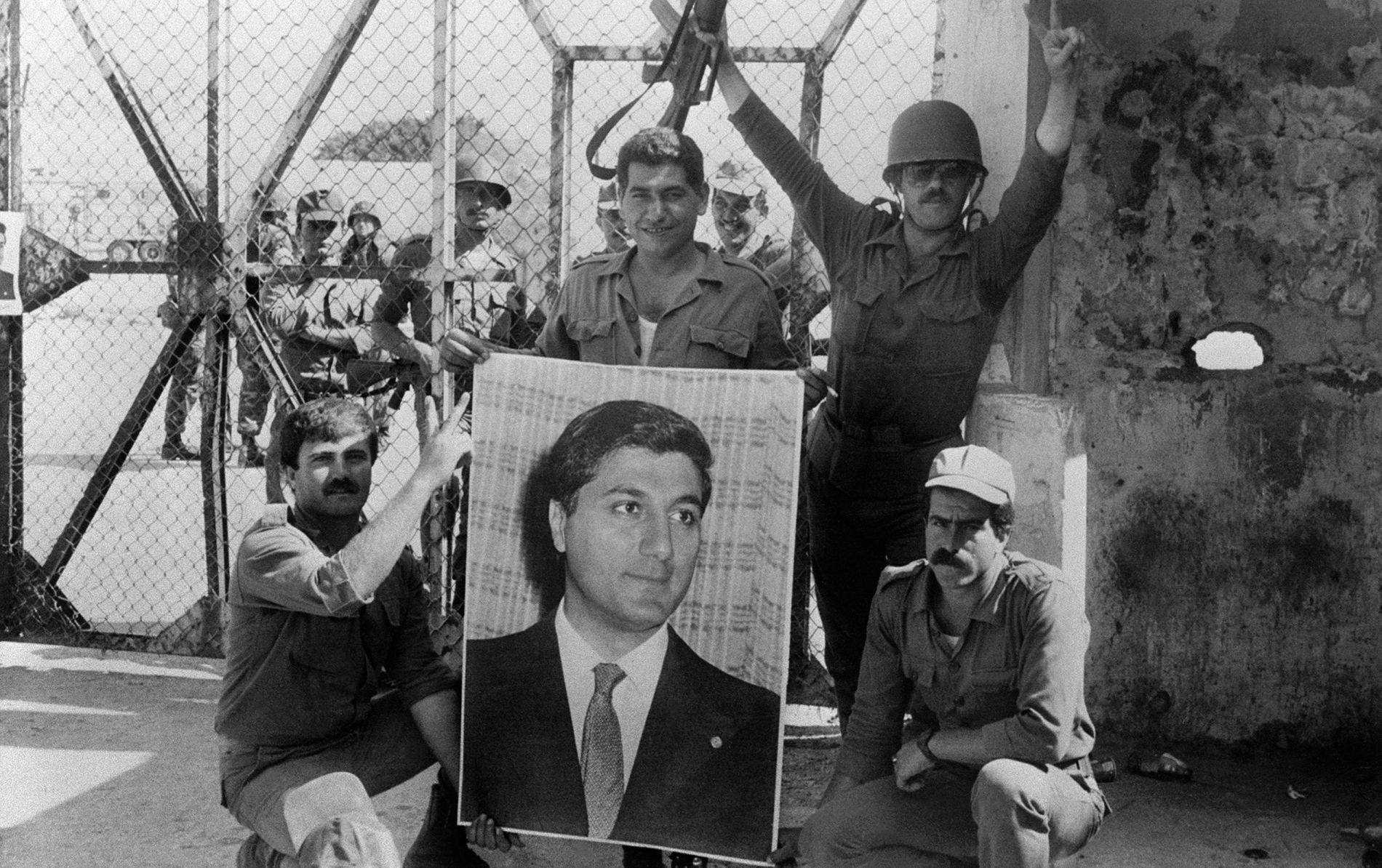
Members of the Kataeb Party display a poster of Lebanon’s newly elected president at the time, Bashir Gemayel, on August 26, 1982.
— Bashir Gemayel: I gave an interview to Al-Magazine, and another interview to Time magazine, which will be published next week. These are the steps we have taken. If you want more, ask for it.
— Sharon: Begin likes you very much, and he was deeply hurt. He felt greatly insulted after all these sacrifices. We attacked the SAM-9 bases—I told you we would attack them. We accept the shedding of blood on our side, but President Chamoun’s statement and your silence hurt us.
— Bashir Gemayel: If that is all the issue is about, it can be dealt with.
— Sharon: I will tell you what created this atmosphere, and then I will explain what we want. I am confident that this atmosphere can be avoided if certain statements are made, efforts are undertaken, or the future relationship is addressed. We should not look to the past now.
I left upset, angry, and uncomfortable. I returned home and could not sleep. I remember when we were once in Beit Meri, and you asked me what we would do when the war was over and the Lebanese had been liberated. I looked toward Baabda and thought that this might be a worthwhile objective.
Your units met me when I was in Kfarshima, led by (Yossi), who was surprised to see me wearing my military uniform. When we reached Beirut, I will be frank with you: we were not prepared to enter the city. We shelled it with artillery and aircraft, but we did not target the city center.
I am pleased that the Americans will provide you with assistance, but they will not give you all the weapons you need. They may help you economically or provide some weapons. In order to overcome the disagreement and the widespread resentment, when I looked at the prime minister (Begin), he was like a schoolboy whose girlfriend had left him to go out with someone else, and that causes tremendous resentment. The prime minister did not ask for much; just a few words would have changed the situation. We were insulted.
As for now, the problems can be divided into two levels. There are several immediate problems, and we will not make any decision without consulting you. In Beirut, there are still 15,000 Palestinians and Syrians inside the city. General leadership structures are still operating. (Palestinian politician) Shafik al-Hout is still receiving and issuing orders. (Popular Front for the Liberation of Palestine–General Command leader) Ahmed Jibril left some men behind, and (Popular Front for the Liberation of Palestine leader) George Habash left approximately 2,000 fighters.
— Bashir Gemayel: We know that, and we estimate the number at around 1,500.
— Sharon: Our objective is to turn Beirut into a different city—a safe city where security prevails. Mr. Draper came to Israel a few days ago and asked me what I meant by a safe city. I told him that when I go to Beirut, I want to be able to stay at the Commodore Hotel. That is a safe city.
I want your opinion. Tell me if you want me to enter the city, kill the Palestinians, and arrest them. Today I was in Bir Hassan, at the Kuwaiti Embassy, so that we could get to them. Do we have permission to enter the city?
— Bashir Gemayel: You cannot do that at present. It is not certain.
— Sharon: I do not mean myself, but my soldiers. Why didn’t we enter the city? Because of the multinational force. Had we entered, those forces would have remained. We made tremendous efforts to advance the Lebanese army. Now that the Americans and Italians have left, the French will leave tomorrow.
— Bashir Gemayel: You can enter if the Lebanese government begins this operation, but that has not happened.
— Sharon: There are several questions. How will you clean up Beirut?
— Bashir Gemayel: Let me give you an example: the Lebanese army enters and encounters resistance, so it fights. I met with the commandos and told them that I cannot give orders at the moment, but after the 23rd of this month (the date I officially assume my duties), I will give the order. They were deeply affected; I raised their morale and captured their attention, and this could produce positive results.
The army is making good progress in Burj al-Barajneh. They enter the streets, and control of Beirut is gradually established, bringing it under Lebanese authority.
— Sharon: Do you want our forces to enter West Beirut freely?
— Bashir Gemayel: We told your general that if our army encountered obstacles from the terrorists, he should undertake to complete the operation and take advantage of the situation to continue the advance. The movements will demonstrate this.
— Sharon: What is your personal opinion?
— Bashir Gemayel: We will use our army to do this. So far, the army is moving slowly. If we plan to enter the camp, the army will share the task with you, but unofficially. The camps where we encounter resistance must be cleared.
— Sharon: If our forces are able to move freely in West Beirut, I want our forces to remain outside Beirut. They will deal lawfully with your men to kill and arrest the Palestinians. Do you want us to participate in this if you request it? We do not want to embarrass you. Where do they want to remain? In the positions where they are currently located.
— Bashir Gemayel: Do not enter today under any circumstances, but remain in your positions, because you are exerting pressure from your current positions, while the Lebanese army will enter from the opposite side.
— Sharon: If your army enters Sabra and Shatila, do you want our units to enter behind them?
— Bashir Gemayel: I think our army can accomplish this task without anyone’s assistance.
— Sharon: Do you want our army to enter behind them gradually?
— Bashir Gemayel: I will give you the answer tomorrow.
— Sharon: Can our units follow your units to search the Sports City and Sabra and Shatila?
— Bashir Gemayel: Yes. You can say that the Lebanese army is inside and that you are entering behind the army to make sure everything is proceeding properly. You can enter behind us to take control of the situation, but there must be no visible coordination with the army on this matter. However, you can coordinate with Hores, Michel Aoun, and Amir Drori.
— Sharon: Then we do not need to wait until tomorrow. This can be carried out in stages.
— Bashir Gemayel: Yes.
— Sharon: Now is not the time to talk about West Beirut.
— Bashir Gemayel: It is not safe. Your soldiers could be kidnapped or killed.
— Sharon: Regarding the port, we control a small section of it. If you want us to leave, we will leave. We learned that a boat carrying tourists is due to leave the port. We will withdraw after they leave.
— Bashir Gemayel: We can take over the entire port.
— Sharon: So you want us to withdraw?
— Bashir Gemayel: We can take control of the port.
— Sharon: Let us suppose that the Lebanese army continues its advance and we are behind it. How do you see things developing once the Lebanese army takes control of Beirut? What will our soldiers do?
— Bashir Gemayel: At that point, you can stay at the Commodore Hotel with your family, and I will come to visit you.
— Sharon: Allow me to ask you about your intelligence services. Can they operate legally in West Beirut?
AFP
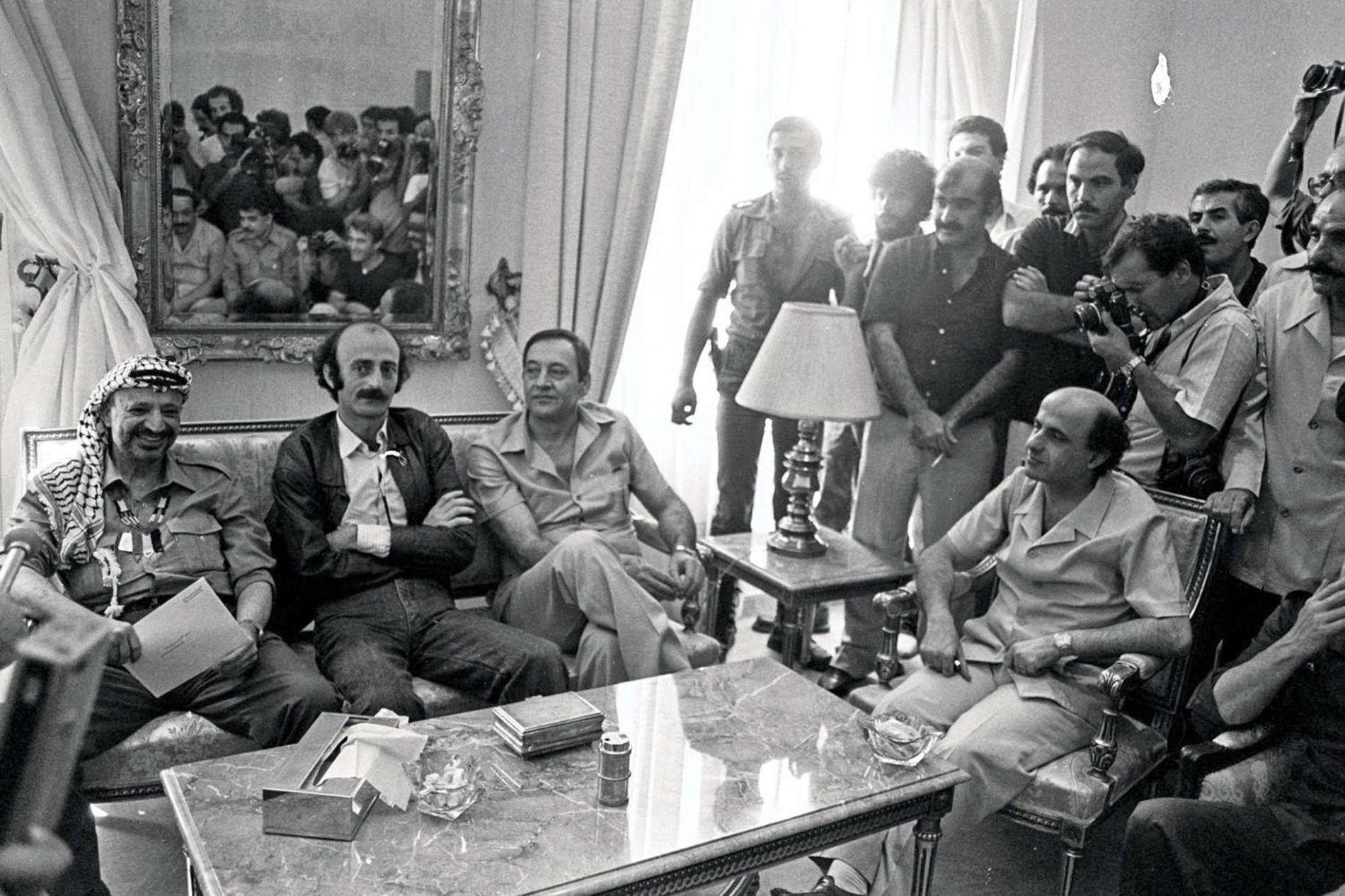
From left: Palestinian leader Yasser Arafat, Druze leader Walid Jumblatt, Amal Movement leader Nabih Berri, and Lebanese Communist Action Organization leader Mohsen Ibrahim during a meeting in Beirut, August 30, 1982.
— Bashir Gemayel: This will be coordinated with (Kataeb Party security official) Elie Hobeika at the highest level. He will coordinate with your people.
— Sharon: The Palestinians are constantly trying to create problems to our advantage. We want to move in coordination, but we think this should begin as soon as possible.
— Bashir Gemayel: We are ready. We will do it through Elie Hobeika.
— Sharon: How much time will your army need to establish complete control?
— Bashir Gemayel: Probably until the middle of October. They lack equipment, manpower, and fighting spirit, but during this period the operation will take on its proper framework. However, they can coordinate with you immediately. Coordination between (probably a Kataeb official) Fadi and Drori is extremely important, as is coordination between Elie and your men.
— Sharon: If we obtain information now about some of the general leadership figures, and if we bring in a large number of special forces personnel, what will your position be?
— Bashir Gemayel: If you have the capability to do it, go ahead.
— Sharon: With your assistance, when will the French leave?
— Bashir Gemayel: Probably Tuesday. They said they would stay if the government asked them to, but the government will not do so.
— Sharon: When our units reached Bir Hassan, Weinberger called Washington, and Washington contacted us through (Lebanese Prime Minister Shafic) al-Wazzan to request the withdrawal of the Israeli units. We prefer not to enter before the 23rd (of September). After that date, you will not ask us to withdraw. I hope that in the future the Lebanese army will take over, and then we will withdraw. I think that by then you will see a city. After that, there will be nothing to restrain our units from advancing into the city.
— Bashir Gemayel: It will be like anywhere else, where you are now.
— Sharon: The day will come when we need cover. When you ask us to withdraw, we will withdraw. That will be after the city has been cleared.
— Bashir Gemayel: Yes.
— Sharon: Let us discuss the American issue. They always tell us that the Lebanese government is requesting this or that. I tell them that the Lebanese government can ask us directly. We do not want dialogue through the Americans. What is your position on this point?
— Bashir Gemayel: You know that we suffered greatly when the Americans did not understand us. You made great efforts so that they could understand us. Now that we have accomplished all that, the Americans see us as an important factor in the country. I told you that if there is tension between you and them, it should not be reflected on us. We must establish the foundations of the relationship between Israel and the United States. We suffered greatly in the past, and now they look upon us as friends and support us. This issue requires extensive discussion. The three of us should sit down together to examine and clarify it.
— Sharon: We do not want to give up our relationship with them (although it is not a close relationship). We warned them that we would destroy the nuclear reactor in Iraq, and they did not believe us. When we told them we would invade Lebanon, they did not believe us. We will not negotiate with the Americans over our relationship with President Bashir Gemayel and his government. We will not deal with you as we do now. They asked us to withdraw our units from Beirut instead of asking Wazzan. I told them that if they want our forces withdrawn, Wazzan should call us directly about it. We do not want America to act as a mediator ( ).
— Bashir Gemayel: I agree with you. When I was ( ).
— Sharon: Suppose the government wants us to do something. We would like to discuss it directly.
— Bashir Gemayel: We have been doing this for years, so why should this change now? If we had a strong government, Habib would have taken different positions. With the next government, things will be different.
— Sharon: Let us take action against the Syrians. Do you have any objection?
— Bashir Gemayel: We would welcome that, and the Lebanese army will provide assistance.
— Sharon: We will attack Sannine from the air. When the men of ( ) enter, we must coordinate with you to carry this out together.
— Bashir Gemayel: You will do it by air and by land. I have some practical matters. There are three problems. At the airport, your people are asking to place an intelligence officer alongside our men to monitor things. I must tell you that the airport security personnel will be under Zahi and Elie. They are enthusiastic and trustworthy.
— Sharon: We asked for one of our men to be in the control tower to speak Hebrew. We do not want to be in the security office.
— Bashir Gemayel: And what is the purpose of that?
— Sharon: We have heavy air traffic, and this is for the safety of the airlines. We have our helicopters making sorties in this area, and we do not want to control the airport. We have two objectives:
- We want to be able to land when we are in Beirut.
- We do not want to control the airport, but there must be a specialist from our side for air safety, not for control.
— Bashir Gemayel: All right, agreed.
— Sharon: We want someone who can communicate with our pilots.
— Bashir Gemayel: The airline ( )—you have the equipment.
— Sharon: We will withdraw it. The man who controls the flight paths ( ) will coordinate with your people, and the equipment will be withdrawn.
— Bashir Gemayel: Could this be presented as a Lebanese request rather than an Israeli one?
— Sharon: Yes. You should request it.
— Bashir Gemayel: I have requested it. Let us see how it will work through the official channels. Then there is the question concerning the major installations in the south. Our men encountered difficulties there initially; pictures of me pasted on cars were torn down. How can we avoid this?
— Sharon: I would like to discuss the issue of peace. This is very important to us. The question is: What are the difficulties? Do you think it is impossible to conclude a peace agreement with Israel? How do you see our role in entering into the negotiating framework?
— Bashir Gemayel: We never said that concluding a peace agreement was impossible. Now is the time to begin this process in order to reach the desired objective. We must overcome two problems ( ).
First, the people from Kaslik who were with you had ( ). The Syrians are here, and it is not true that they will not attack us. We have half a million Christians under their control. If the agreement is signed before September 23, while the situation remains as it is now, there will be retaliatory actions against our people.
Second, consider our borders. When you withdraw, the borders will not be secure. The Syrians could enter from several points. There are 160 kilometers of open territory ( ) into Lebanon. Since 1943, Lebanon has had no buffer along its borders. The Syrians will launch raids into the Bekaa and Zahle ( ) if the peace agreement is signed before they leave.
— Sharon: Do you expect them to leave?
— Bashir Gemayel: I don’t think so. At Fez, they said they would leave after you leave.
Second—and here I ask you to understand me—I did not say that I want to remain with the Arab world and receive money from them, nor do I care about Arab interests in Lebanon. All that matters to me is that 60 percent of Lebanon’s revenues result from the presence of 300,000 Lebanese, most of them Christians, in the Gulf states, who send money to Lebanon. The problem is not cutting relations with the Arab states. The problem is not political; it is an internal economic issue that could leave us facing a deficit.
— Sharon: The Egyptians have two million people in the Arab world, and nothing happened to them.
— Bashir Gemayel: The Americans helped the Egyptians. Could the Americans become involved in this process? Besides, the Egyptians are Muslims, not Christians.
— Sharon: [Reference to all ( )].

AFP
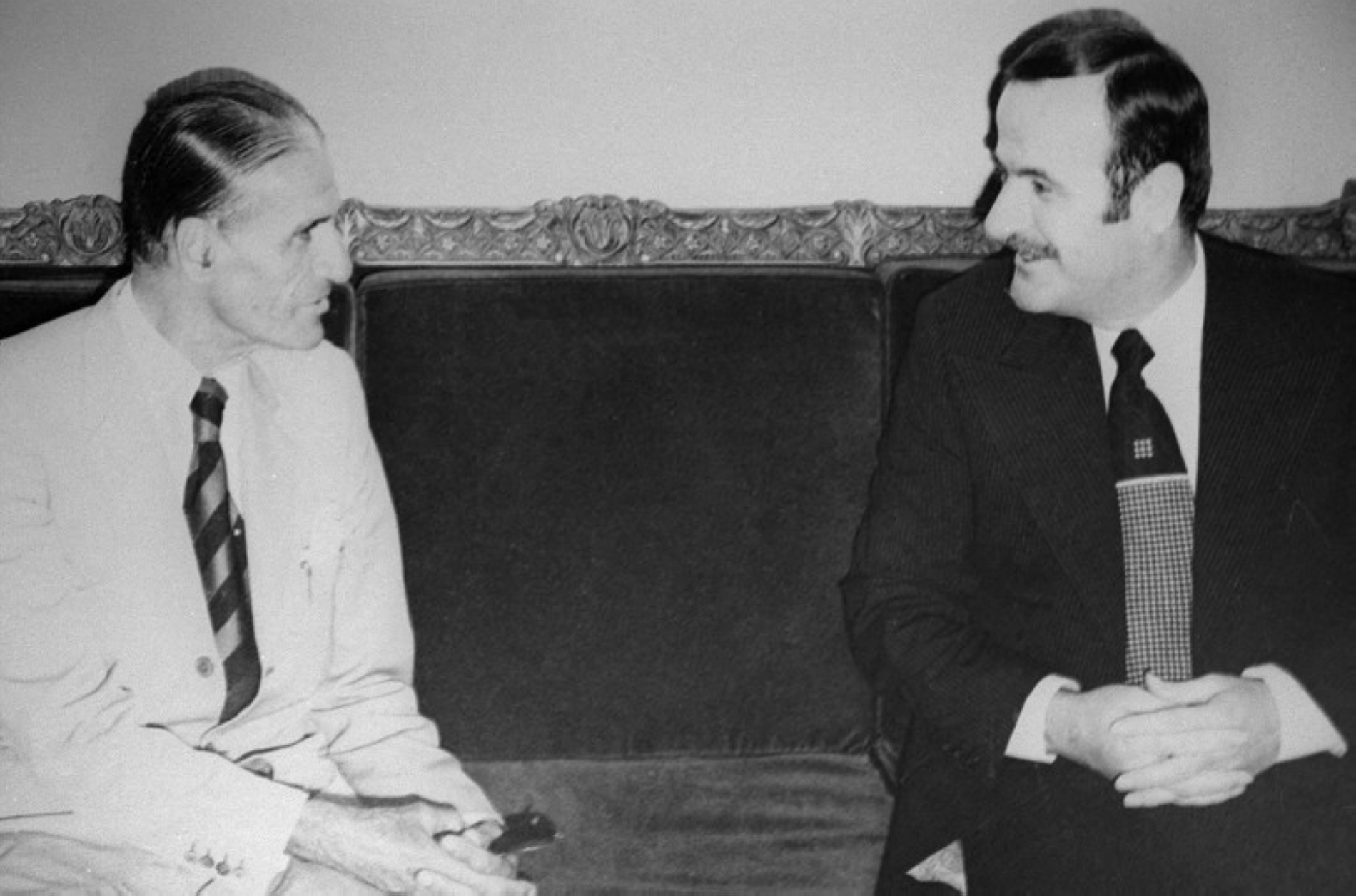
Hafez al-Assad with Pierre Gemayel during their meeting in Damascus on September 26, 1973.
— Bashir Gemayel: There are some observations.
— Sharon: There are concerns ( ).
— Bashir Gemayel: Yes.
— Sharon: The Syrians are constantly laying claim to Lebanon. They will never leave; they will always want to control it. You must defend your borders, fortify them, and take responsibility for them. We have hundreds of kilometers [of border]; we have a system for managing them, and we can show it to you. If Zahle is in danger, we can intervene directly. We were 120 kilometers from Zahle and intervened; now we are 15 kilometers away, so there will be no problem.
Economically, a solution can be found to this issue. The Jordanian authorities allow 1.2 million people to cross each year. There are goods exported from Israel to Kuwait. This issue is extremely important to us, and I have an idea about how it could be addressed. For us, it is a matter of vital importance.
The best relations, cooperation, and friendship existed behind the scenes, and we practiced that for years. When I came to Beirut, I felt safe, as though I were in my own country. The ( ) president is that we are human beings. We have good relations because you and I are here, but we are human beings. During the war, my helicopter was forced to land in catastrophic circumstances, and nothing happened; we were not harmed. I am glad that you are in perfect health, but who knows what might happen.
When a peace agreement is signed, and when you and I are no longer here, or no longer hold any official positions, the agreement will enable our two countries to endure. Relations between states must not be based on individuals.
— Bashir Gemayel: What would the agreement contain?
— Sharon: Let us sit down and enter into the peace-negotiation process. Let us do it secretly.
— Bashir Gemayel: You cannot keep this secret.
— Sharon: I am sorry, but the matter has not gone beyond my government. No one knows that I am here now. It will be secret. We will discuss the broad outlines; we have to discuss them. We must enter into the mechanism that will lead us to a peace agreement. This will take place when normalization occurs between our two countries. Guarantees against ( ) concerning your country will be incorporated, and in the future you will be able to ( ) with strength. We are prepared to help you. There will be mutual guarantees ( ). A document can be placed in the hands of your team and ours, and we can work on a working file between us.
— Bashir Gemayel: Your goods enter our country at lower prices because you do not pay customs duties.
— Sharon: That can be included in the agreement. All economic, political, military, and other aspects must be discussed. The best thing that can be done is for both sides to make concessions. The prime minister should not be blamed; he spoke to you like a father who had been insulted by his son.
— Bashir Gemayel: What would have happened if we had spoken in this calm manner?
— Sharon: This man is suffering because of his leg and because of you. His dream was to see you elected. I never believed this would happen. When we were in the village, people knew you. They love you—the way they speak to you and their admiration for you. This may help you now.
The matter is that ( ). The man was waiting for something—a word from you. We have been subjected to a fierce campaign by the opposition. Even now, they are asking us to leave Beirut, move to the 40-kilometer line, and bring in multinational forces.
A peace agreement could put the two countries into genuine peace. Security is in both our interests. The opposition asks: What happened to Bashir? He did not say a word. We may face elections. You have to understand that this affects us. Our war must be limited to Lebanon and must not extend to Syria.
They asked us how the gains would be preserved afterward. I answered that there would be a Lebanese government. Syria’s withdrawal could help in forming a government. The government should demand the withdrawal of all foreign forces.
The man (Begin) has been deeply hurt. To this day, he feels that he has been betrayed. He asked for one word ( ), or for an end to the war. When he gets angry, he is extremely tough. I think it is important to form a committee to study this project.
— Bashir Gemayel: Whom do you propose from your side?
— Sharon: The prime minister said that Shamir and I would represent our side. I will handle this matter, and everything will go through Hebrew. General Tamir will prepare the working papers with your men.
— Bashir Gemayel: On my side, I appoint Joseph Abu Khail and Zahi Bustani to prepare the working papers.
— Sharon: You, I, and Mr. Shamir will handle the matter at the senior level ( ). I have also added Tamir and David Kimche.
— Bashir Gemayel: Can you keep this secret? I have to form a new government and persuade it to support the project.
— Sharon: Yes. If we can hold a meeting—you, me, and Shamir—to arrange a secret meeting to launch the project, we can hold it on Wednesday evening, the 15th of this month.
— Bashir Gemayel: All right.
— Sharon: Let us not complicate or make things more difficult.
Getty Images
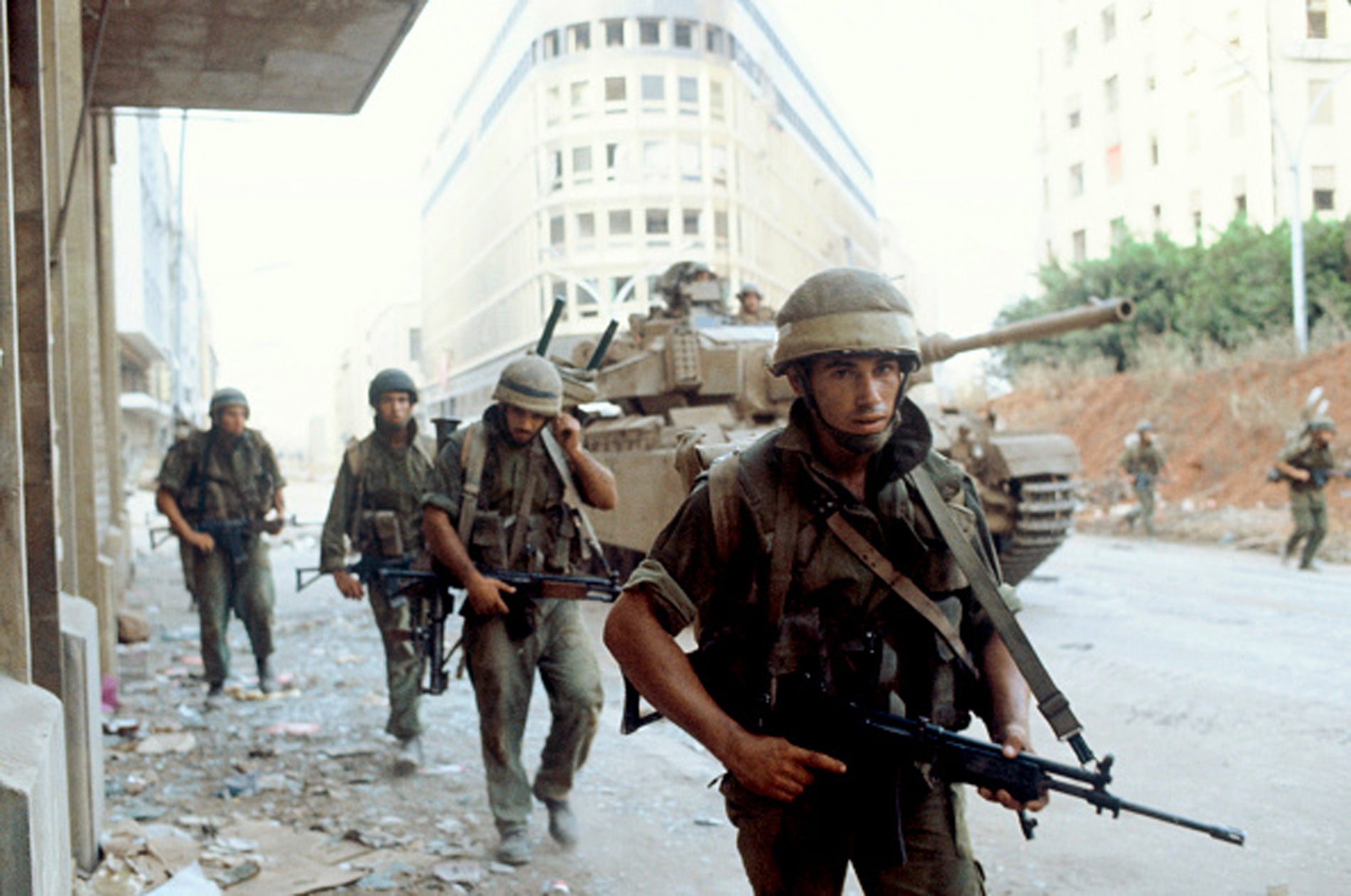
Israeli forces in West Beirut following the assassination of Bashir Gemayel, 1982.
— Bashir Gemayel: Any time in the afternoon.
— Sharon: This will be the beginning of the negotiations and will ease the tensions.
— Bashir Gemayel: Do you want to deal with the issue of Saad Haddad now or later?
— Sharon: We will deal with the matter between us, as friends. The south is a fundamental issue for our nation. If we are to conclude a peace agreement, and in order to keep the matter secret, these issues must not be discussed except with people very close to you.
We may need to hold a summit meeting between the prime minister and you when we reach a point of disagreement or an issue of fundamental importance.
The Americans asked us to sell tanks to the Lebanese Army, and I am not hiding any secrets from you. They asked us to sell 12 tanks to the Lebanese Army, so we told them we were prepared to fulfill this request if it were made directly to us by the Lebanese Army. We do not want to sell them to the United States so that it can then sell them to your army.
I want to tell you that we have thousands of tons of ammunition taken from the terrorists. Your equipment is Soviet-made, and we would like to obtain some weapons from you that you will not need in the future.
— Bashir Gemayel: Of course. Abbas will take care of this matter, but we have a great deal to do. I will inform Fadi about the airport and Sannine.
— Sharon: Yes, we can attack the Syrians within the next two days.
The meeting ended at 2 a.m. on September 13, 1982. Bashir Gemayel was assassinated on September 14, 1982.