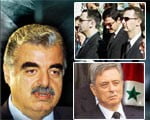
The Syrian President Commits His Forces to the Fighting and Requests Weapons from the Soviets… While U.S. Envoy Habib Urges Him to Withdraw and Complains of “Israeli Intransigence”

On the evening of June 6, 1982, the Israeli Cabinet issued a statement addressed to Damascus, which was delivered through the Americans to Syria’s ambassador in Washington, Rafic Jouejati. It read as follows:
“The Cabinet has taken the following decision: Instructions are hereby given to the Israel Defense Forces to keep all the civilian population of Galilee out of range of fire from the terrorists in Lebanon, where their bases and forces are concentrated.
The name of this operation is ‘Peace for Galilee,’ and during this operation the Syrian army will not be attacked unless it attacks our forces. Israel continues to look forward to signing a peace treaty with an independent Lebanon, whose territorial integrity will be secure.”
Damascus responded by sending additional forces toward the fronts, deploying the Syrian air force in the battle, and sending some special-forces units to Sidon, disguised as Palestinians, to participate in the defense of the city. The Syrian army command also called up reservists for mobilization.
For Assad, it was necessary to inform his ally, the Soviet Union, with which Syria had signed a “Treaty of Strategic Friendship.” Damascus approached its Soviet allies, saying that the Israeli military operation was aimed at “eliminating the Palestinian presence in Lebanon” as a fundamental step toward eliminating the Palestine Liberation Organization (PLO) and the Palestinian revolutionary forces.
On June 7, Foreign Minister Abdul Halim Khaddam summoned the Soviet ambassador, Viktor Fedorov. According to the minutes of the meeting, he told him:
“With reference to the cooperation between the two countries, as well as consultation and the exchange of views, the Syrian leadership, having studied and analyzed the Israeli aggression against Lebanon, would like to inform the Soviet leadership of the following:
We believe that these extensive acts of aggression were carried out in consultation and coordination between the United States and Israel, and with certain circles in the region. These operations have the following objectives:
- To eliminate the Palestinian presence in Lebanon as a fundamental step toward eliminating the Palestine Liberation Organization and the Palestinian revolutionary forces.
- To force the Lebanese government into negotiations to conclude a peace agreement with Israel, bring Lebanon into the orbit of ‘Camp David,’ remove Syria from Lebanon, and eliminate the Lebanese national forces.
- To place Syria in a predicament: either it remains silent and stands by as an observer while Israeli aggression continues, in which case it will be subjected to accusations and isolated Arably and internationally, after which the Israeli forces will launch an attack against Syria, at which point it will find no voice standing by its side.”

AFP
A photograph dated July 21, 1982, showing Israeli soldiers on alert in an armored vehicle in Beirut.
The Syrian leadership had decided, from the outset of the escalating situation, to provide whatever assistance it could to the Palestinian resistance and the Lebanese national forces, while trying to avoid direct confrontation, particularly since we had no military presence in the southern region. With the Israeli forces advancing along the axes where our forces were deployed, however, confrontation became inevitable, and our forces did in fact engage the enemy forces along these axes.
In view of this dangerous situation, the Syrian leadership hopes that the friendly Soviet leadership will expedite the delivery of the weapons that had been agreed upon, particularly those related to air defense and air power, because the gaps in these areas are substantial and dangerous. We believe that Marshal Kutakhov and General Aftimov are fully informed about this matter.
The armed forces are also suffering from a severe shortage of ammunition, which is another cause for concern. Therefore, the Syrian leadership hopes that the Soviet leadership will work to make up the substantial shortfall in ammunition.
4- The Syrian leadership would like to be kept informed of the Soviet leadership’s assessment of the developments underway and those that may occur, and of how they should be confronted.”
The Soviet ambassador promised to convey the message immediately to Moscow, which was still grappling with the repercussions of the Soviet missile crisis that had occurred a year earlier. At the time, Syria held sway over the Bekaa Valley, where surface-to-air missiles had been deployed since April 1981 after Syrian forces on Mount Sannine came under attack by Israeli aircraft.
That summer, in 1981, the Israeli army shot down two Syrian helicopters in the Bekaa Valley while they were on missions in Zahle and Sannine in Lebanon. Assad responded by deploying the Soviet-supplied SAM anti-aircraft missiles in the Bekaa Valley.
Begin threatened Assad that the missiles would be removed by “special means” unless Damascus withdrew them, a demand Assad rejected. The crisis became known as the “missile crisis,” in reference to the Cuban Missile Crisis between U.S. President John F. Kennedy and Soviet leader Nikita Khrushchev in the early 1960s, which ended with Moscow withdrawing its missiles from Cuba.
There is no doubt that the coincidence of the Syrian missile crisis with Israel’s bombing of Iraq’s nuclear reactor further complicated matters. Regional and international interventions were required to reach understandings and overcome the “missile crisis.”
Some have argued that this crisis marked the beginnings of Israel’s invasion of Lebanon in June of the following year. During the 1982 invasion, the United States conveyed “messages” from Tel Aviv to Assad indicating that Israel did not want to fight the Syrians as long as Syrian forces in Lebanon did not attack them. Tel Aviv assured him: “There will be no action against them,” and asked President Hafez al-Assad to order the fighters of the Palestine Liberation Organization operating alongside Syrian forces in the Bekaa Valley to withdraw 25 kilometers north of the Israeli border. If the Syrian president accepted Israeli Prime Minister Menachem Begin’s proposals, the military phase of Israel’s operation in Lebanon would end and a ceasefire could take effect.
The UN Security Council had adopted Resolutions 508 and 509 on June 5 and 6, respectively, calling for an unconditional cessation of hostilities. Resolution 509 demanded “that Israel withdraw all its military forces forthwith and unconditionally to the internationally recognized boundaries of Lebanon.” The Palestine Liberation Organization announced its acceptance of the resolution, but the Israeli forces continued their military operations, leading to intense confrontations with Syrian forces in the Bekaa, Mount Lebanon, and Beirut.
On June 8, Syrian Assistant Foreign Minister Nasser Qaddour received U.S. Ambassador Robert Paganelli, who said:
“I have an urgent message from [U.S. envoy] Philip Habib, sent from Begin’s office. It is a message from Begin to President Assad. The message says:
1- Israel does not want to fight the Syrians.
2- If the Syrian forces do not attack or attempt to attack the Israeli forces in Lebanon, nothing will happen to the Syrian forces.
3- Israel has observed movements by some Syrian forces in the lower Bekaa, several kilometers west and south of their positions as they were on June 5. It requests that the Syrian forces be withdrawn and returned to the positions they occupied on Saturday, June 5.
4- Israel asks President Assad to order the Palestine Liberation Organization forces operating alongside the Syrian forces in the Bekaa to withdraw an additional 25 kilometers north of the Israeli border.
If President Assad accepts these proposals from Begin, the military phase of Israel’s operation in Lebanon will end and a ceasefire can take effect. Prime Minister Begin will make no public statement or comment regarding this message.”
When Qaddour said, “This is Begin’s position. What is your administration’s position?” the ambassador replied:
“The instructions I have received are to deliver this message to you so that you may convey it to the President, and Philip Habib is prepared to come immediately if he is given the opportunity to meet with the President.”
Damascus regarded Begin’s words as a threat and refused to respond to them. During his meeting with the American envoy in Damascus, Qaddour said:
“What kind of prime minister is this, asking the envoy of the American president to act as his messenger? The Israelis have no shame.”
Habib Demands That Assad Withdraw to the “June 5 Line”
According to the official Syrian view, U.S. policy under President Ronald Reagan was characterized by a spirit of confrontation in international relations, but in the Arab-Israeli conflict it sought to contain the conflict. It also sought to engage Assad and Arafat through Farouk al-Qaddoumi, head of the PLO’s political department, who in mid-1982 received an invitation to visit Washington, extended by Representatives Lee Hamilton and Paul Findley.
On June 9, 1982, Reagan sent his Middle East envoy, Philip Habib, to Damascus to meet with the Syrian president. Habib said that the U.S. administration did not agree with Israel’s decision to annex the Golan Heights because it was “unbalanced” and lacked convincing justification. Habib said:
“Our objective now is a ceasefire and the Israeli withdrawal from Lebanon, while preserving Lebanon’s territorial integrity within its internationally recognized borders. How do we move from where we are now toward achieving that objective?”
Habib asked Assad to return the Syrian forces to their previous positions in order to ensure a secure zone extending 40 kilometers. This was complicated by the fact that among the forces deployed east of the Bekaa, and in Hasbaya and Jezzine up to the Syrian border, were Palestinian factions aligned with Syria and temporarily allied with Yasser Arafat in confronting the Israeli invasion.
Assad replied that these Palestinian factions were “incapable of shelling,” but the Israelis said they were capable of firing 130-millimeter artillery and Katyusha rockets, and that they had intermingled with the Syrian forces so that Israel would not attack them.

Getty
U.S. envoy Philip Habib
The Americans reiterated to President Assad that Israel did not want a military confrontation with Syria, and proposed the withdrawal of the Syrian and Palestinian forces from the positions occupied by the Syrian army within the 40-kilometer zone. Philip Habib said:
“There is no objection to the presence of Syrian forces as deterrent forces anywhere they had been stationed before June 5. If this is done, Israel considers the military phase of its operation to have ended, and a ceasefire can be implemented throughout Lebanon.”
After some back-and-forth, Habib said that Israel and the Palestinian factions would withdraw to the 40-kilometer zone, while the Syrian forces would remain in the positions where the deterrent forces had been before June 5.
Assad replied:
“In Israel, they do not tell the truth. The military operations are an expansionist invasion. They were the ones who started the fighting against the Palestinians, the Lebanese, and the Syrian forces, not the other way around. When they say that they are targeting only the guns shelling the villages of Galilee, or even attacking the fedayeen bases, what does that have to do with their attacks on the Syrian forces in the Bekaa? And what does it have to do with their advance into the Chouf and Mount Lebanon? As far as I know, there are absolutely no fedayeen in this area, and this area is also beyond the 40-kilometer zone. In light of these facts, how can we believe what the Israelis are saying?”
Habib replied:
“That is correct. They have gone beyond the 40-kilometer zone, and this is what is causing the escalation. We now want de-escalation, and I know that they have escalated, for example, in the western area and reached the Damour area, which is 80 kilometers away. They are now trying to seize the Damascus–Beirut road. This is the escalation, and we want to return them to their previous positions, then make arrangements for their complete withdrawal from Lebanon. That is why I say there must first be a ceasefire, then a withdrawal, and then the final arrangements. This is the sequence, preceded by the issue of removing the Palestinian forces from the position they currently occupy.”

AFP
The late Syrian President Hafez al-Assad
Assad replied:
“This is aggression against us… This is an invasion of Lebanon and an invasion against us. They came in order to take control of the road between Damascus and Beirut, and this is something we cannot allow, even if we have to fight a hundred wars. We cannot allow them to cut the road to Beirut, because we have forces in Beirut, Sofar, and Bhamdoun. We did not work toward escalation, nor did we initiate the fighting, and we have no desire for escalation. The Syrian forces want security and calm to return to Lebanese territory, because this is in the interests of Syria, Lebanon, the Palestinians, and everyone.”
The Forces Remain in Their Positions
As for the Syrian forces, Assad agreed that they should remain in their positions. As for the Palestinian factions aligned with them in the Bekaa, “this is not within our authority or our responsibility. Matters concerning them cannot be discussed.” He added that the matter was for them and for Lebanese President Elias Sarkis.
“What does it mean to ask Syria to remove a fedayeen base? No one believes that this request is being made because the base poses a danger. This is a fundamental political issue. The aim is to destroy the base and thereby impose Israel’s will on us. This request is unreasonable, especially when it is made to Syria.”
That evening, Assad met with Philip Habib again. Habib told him:
“President Begin has requested an immediate ceasefire, effective at six o’clock tomorrow morning, Lebanon time.”
Time passed and six o’clock arrived. Everyone agreed to the ceasefire except Assad, who insisted that it cover all of Lebanon, not just the Bekaa Valley.
He told Habib:
“I agree to a ceasefire on the condition that withdrawal is the first step and that it begins immediately with the ceasefire, because in practical terms there will be no ceasefire unless it is accompanied by a withdrawal.”
The president continued:
“I do not want anything to remain unclear… What I understood from you is that the withdrawal will be from all Lebanese territory. It is true that we are not negotiating over Lebanese territory, as that is a matter for the Lebanese authorities. But if Israel does not withdraw from all Lebanese territory, we will fight in defense of Lebanese territory, because we know Israel and have experience with it.”
The president then asked him:
“If Israel does not withdraw, what will the position of the United States be?”
Habib replied:
“We are moving in that direction. The message says that Israel must withdraw.”
The president said:
“Then let us summarize what you have said as follows:
- The Palestinians are to be removed from the Hasbaya and Jezzine area, to a distance of 40 kilometers from the border.
- A ceasefire.
- Israel withdraws to a distance of 40 kilometers from its border.
- The Syrian forces remain where they are as deterrent forces.
- Negotiations and arrangements are to be conducted to establish a stable situation in the south, followed by Israel’s complete withdrawal.”
The president continued:
“The fedayeen had been committed to the ceasefire, but after they were attacked in Beirut and the south, they defended themselves. Their commitment to the ceasefire is based on the Arab resolutions adopted at the Tunis summit [held in November 1979 following the first Israeli invasion]. The Israelis must understand that they cannot impose anything against our interests, Lebanon’s interests, or the Palestinians’ interests.
“We cannot negotiate on behalf of the Palestine Liberation Organization, nor on behalf of the Lebanese. You are asking us to do things that do not fall within our authority. Our authority concerns the Syrian forces alone. Asking Syria to remove a Palestinian base is a political matter that conflicts with our principles and values.
“A ceasefire without withdrawal serves Israel’s interests. Therefore, I believe the ceasefire should be accompanied by an immediate withdrawal to specified positions, followed by the beginning of a comprehensive withdrawal.”

AFP
Palestinian leader Yasser Arafat among his fighters in Beirut during the early days of the 1982 Israeli invasion of Lebanon.
Habib replied: “I will convey this to President Reagan, and I will inform you of the response.”
At 11 p.m. on June 10, President Assad received Philip Habib for the third time during his stay in Damascus. Habib appeared deeply dejected as he told his host:
“I requested this meeting to brief you on the contacts we have had with the Israelis. Secretary Haig called me and said that he had been planning to go to Israel, but Israeli intransigence prevented him from doing so. Haig is frustrated with the Israeli position because they do not agree to a ceasefire without conditions. The withdrawal will not take place until they know what the new situation in Lebanon will be.”
The following morning, Israel announced a unilateral cessation of hostilities provided that the other parties abided by it. The fighting stopped for several hours, but Israel resumed its operations in the Beirut and mountain areas, with the aim of reaching the Lebanese capital, eliminating the Palestinian presence there, and cutting the Beirut–Damascus road.
Indeed, as Assad had anticipated, Israel launched its military campaign to seize control of the Damascus–Beirut road on June 22. On June 24, Israeli forces reached the town of Chtaura, where Syrian-Lebanese summits had been held because of its location on the international highway linking the two capitals.
As for the siege of Beirut, it began on June 14 and continued until August. It ended only after 14,000 Palestinian fighters withdrew, with their forces dispersed among Syria, Jordan, and Yemen, while their leadership went to Tunis as guests of President Habib Bourguiba.