Damascus Rejects Linking the Syrian Withdrawal to the Israeli Withdrawal

After Yasser Arafat’s departure from Lebanon in the summer of 1982, the United States maintained its military presence and provided substantial support to President Amin Gemayel, who succeeded his brother, “Sheikh Bashir,” after the latter was assassinated by a member of the Syrian Social Nationalist Party on September 14, 1982. The Reagan administration insisted on keeping its forces in Lebanon, saying they would withdraw only at the request of the Lebanese authorities. It justified its decision on the grounds of combating Soviet influence in the region and Iranian influence in southern Lebanon, which was beginning to emerge clearly through armed militias that later gave rise to Hezbollah in 1984.
“Operation Blue Bat”
This was not the first American intervention in Lebanon. It had been preceded by a similar military intervention in 1958, at the request of then-President Camille Chamoun, who was aligned with the West and was struggling against a popular uprising launched by supporters of Egyptian President Gamal Abdel Nasser with backing from Syria’s “Second Bureau,” the military intelligence service. The administration of President Dwight Eisenhower sent 14,000 American troops to the Lebanese coast at the time, most of them Marines. They arrived in Beirut on July 15, 1958, one day after the armed revolution in Iraq that overthrew King Faisal II, who, like Camille Chamoun, was aligned with the West and the United States. Through “Operation Blue Bat,” the United States sought to protect Chamoun from meeting a fate similar to that of the Iraqi king and to curb the spread of communism in the Middle East. The troops were instructed to secure Beirut International Airport and protect Chamoun from the Nasserist popular unrest in Lebanon. They withdrew on October 25, 1958, after securing the president in Baabda Palace until the final minute of his constitutional term and replacing him with the powerful General Fouad Chehab as Lebanon’s president.
Many of the protagonists of the 1958 crisis were still active on the Lebanese scene in the early 1980s. Camille Chamoun himself, allied with the Kataeb Party and opposed to the Syrian presence in Lebanon, was still active. Despite being over eighty years old, he directed a military militia in the civil war through his sons. Sheikh Pierre Gemayel, the head of the Kataeb Party, was also still at the helm, allied with Chamoun as he had been in 1958.
The opposing camp, aligned with Syria, had in 1958 been represented by Druze leader Kamal Jumblatt, Maronite leader Hamid Frangieh, and Sunni leader Saeb Salam. Jumblatt was assassinated in 1977 and was succeeded by his son, “Walid Bey,” who was allied with the Syrians in 1982 before turning against them in the aftermath of the assassination of Prime Minister Rafik Hariri in 2005. Hamid Frangieh withdrew from political life and was succeeded by his brother, Suleiman, as head of the Frangieh family in Zgharta and leader of the Marada militia. He was later elected president of the Lebanese Republic in 1970, and his presidency witnessed the outbreak of the civil war in 1975.
Israel itself had not changed between 1958 and 1982, nor had the United States, except in terms of identifying the enemy. Whereas the objective in the 1950s had been to curb communism, U.S. foreign policy in the 1980s revolved around combating “Khomeinism” and limiting the influence of the Islamic Republic of Iran, which had come to power in 1979.

Getty
Lebanese President Amin Gemayel delivers a speech in front of the White House on December 1, 1983, with U.S. President Ronald Reagan and Secretary of State George Shultz seen behind him.
The May 17 Agreement
With the direct support and supervision of President Ronald Reagan’s administration, Lebanese President Amin Gemayel entered into direct negotiations with Israel in late 1982. These talks led to the signing of the May 17, 1983 Agreement, which was intended to end the state of war between the two countries and provide for the withdrawal of the Israeli army within 8–12 weeks.
The Lebanese Parliament convened to discuss and vote on the agreement, with 19 lawmakers absent, most of them aligned with Syria and opposed to Israel. Many Christian parliamentarians voted in favor of the May 17 Agreement, including Camille Chamoun and Pierre Gemayel, the father of President Amin Gemayel. Notably, they were joined by the prominent Shiite lawmaker Abdel Latif Baydoun, from Bint Jbeil in southern Lebanon. Former Prime Minister Rashid al-Solh abstained from the vote, as did the prominent Shiite lawmaker Hussein al-Husseini, who years later became Speaker of Parliament and was one of the architects of the Taif Agreement.
The May 17 Agreement sought to impose a peace treaty between Lebanon and Israel, ultimately aiming to remove the pretext for the continued presence of the Syrian army in Lebanon, in parallel with the withdrawal of Israeli forces that had invaded Beirut in June 1982 and withdrew from the city on September 29 of the same year, following Arafat’s departure.
Before the start of the Israeli-Lebanese negotiations, U.S. envoy Philip Habib arrived in Damascus on October 23, 1982, hoping to persuade the Syrians of the need to withdraw from Lebanon. His visit to Syria was prompted in part by President Hafez al-Assad’s visit to Moscow that same month, where he secured Soviet approval for the deployment of two air-defense regiments equipped with SA-5 missiles in Syria. This enhanced the Syrian army’s combat capabilities and readiness to confront Israel in Lebanon.
At the time, Syria held sway over the Bekaa Valley, where it had deployed surface-to-air missiles in April 1981 after its forces on Mount Sanin came under a heavy Israeli air attack. Assad refused to receive Philip Habib, who instead met with Foreign Minister Abdul Halim Khaddam and said: “The opportunity has arisen for us, for you, and for Israel to create an independent Lebanon. There is a government in Lebanon that wants to maintain the best possible relations with the Arab world and to be master of its own house.” Habib added: “That will not be achieved unless all foreign forces leave Lebanon.” Khaddam replied that the gap between the two countries remained wide, rejecting any linkage between a Syrian withdrawal and an Israeli withdrawal.
Khaddam asked about the arrangements the U.S. administration was considering for Lebanon. Habib replied: “A security zone, open borders, no heavy weapons in the security zone, and electronic monitoring stations within Lebanese territory.” He said the Israelis did not agree to the presence of UNIFIL and wanted a certain level of dialogue, including a meeting with the Lebanese in the city of Jerusalem. He told Khaddam: “The Lebanese can speak for themselves, so that the Israelis will deal with them seriously on these matters.”
Khaddam replied that Lebanese President Amin Gemayel did not represent all Lebanese. Habib responded that Gemayel enjoyed the support of prominent Sunni Muslim figures such as former Prime Minister Saeb Salam, as well as influential Druze figures such as former Defense Minister Emir Majid Arslan. He explained: “President Gemayel knows how to protect Lebanon’s sovereignty and preserve its independence, and we will give them our support.”
The Syrian side responded that Gemayel would never have obtained such broad backing and support from the political class had Syria not intervened on his behalf following the killing of his brother and arranged a reconciliation between him and former President Suleiman Frangieh.
The following dialogue then took place:
Khaddam: Did the Israelis request some form of air and naval surveillance over Lebanon?
Habib: They requested the right to conduct patrols in Lebanese territorial waters. This is not a hostile act. We must be practical in order to reach security arrangements.
Khaddam: What about the withdrawal and what happens afterward?
Habib: At this stage, let us remember that there are no negotiations. We are arguing about how there could be negotiations, if there are to be any.
Khaddam: I am asking about the Americans’ view, not the Israelis’ view.
Habib: As for the withdrawal, you do not believe that the timeframe should be prolonged or that it should take months. However, I am not saying ten days or two weeks; it should be a short and clearly defined period. Nor should the withdrawal be divided into small pieces, like slicing a piece of sausage. You are now facing the Israeli forces… from Sofar to the Bekaa… and I believe there is room for separation. It should be linked to a process that leads to a comprehensive withdrawal, rather than having each side remain in place for months and months. The Lebanese cannot be expected to be patient with that.
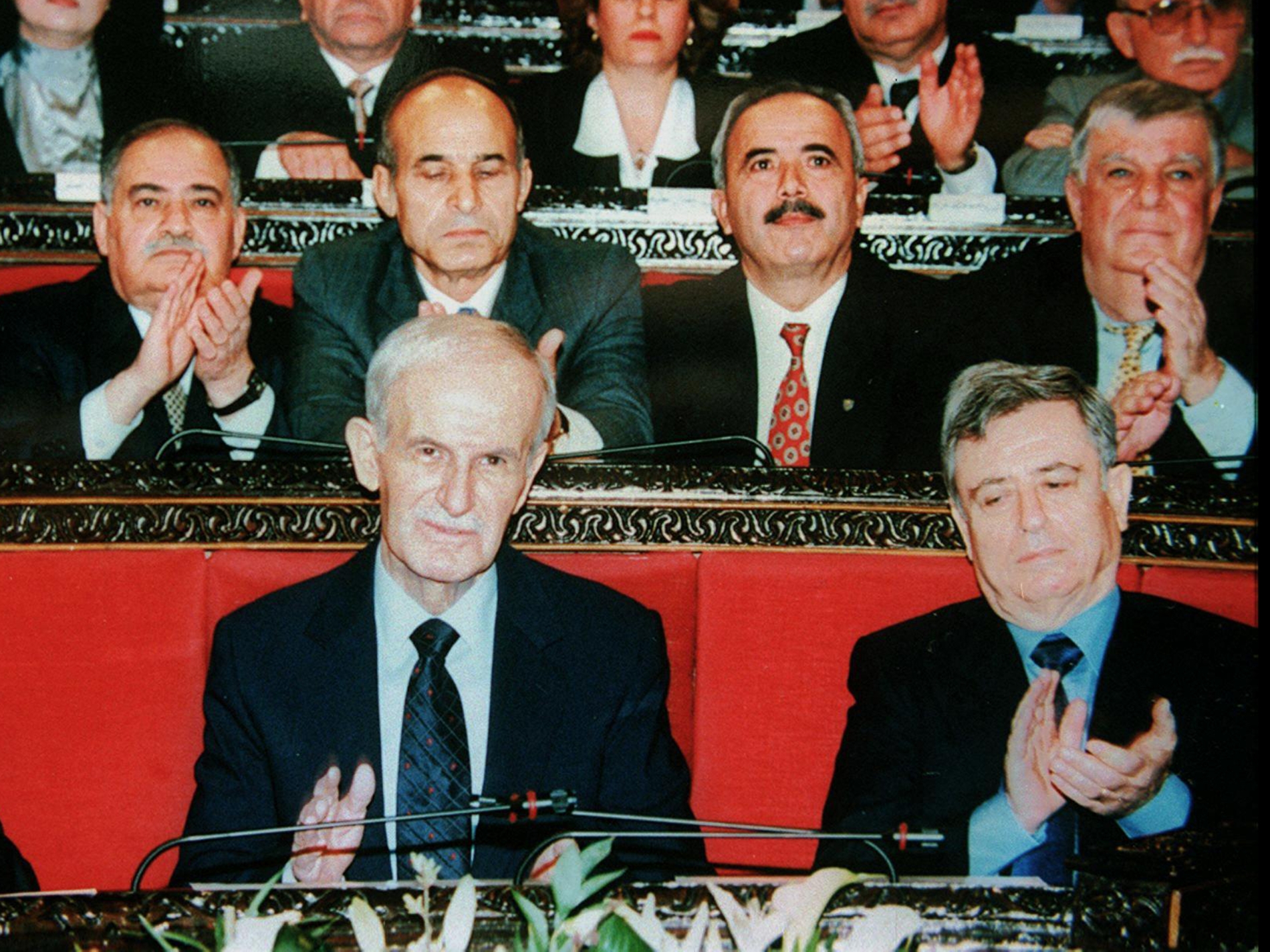
President Hafez al-Assad (center) is applauded by his Vice President Abdul Halim Khaddam (right) and Syrian lawmakers on March 11, 1999, during a ceremony marking his swearing-in for his fifth presidential term.
The Entry of Syrian Forces… and the Quagmire for Assad
The argument put forward by the Americans in the negotiations that preceded the May 17 Agreement was the same argument used by former Secretary of State Henry Kissinger when he called for the Syrian army to intervene militarily in Lebanon in 1976. The beginning of the Syrian intervention took a dual form: through regular forces that entered Lebanon on May 30, 1976, and through the “Arab Deterrent Force,” approved at the Riyadh Summit on October 17–18, 1976. The Deterrent Force eventually numbered 35,000 fighters, 30,000 of them Syrians, with the remainder from various countries, including Libya, Saudi Arabia, and Sudan.
The Americans wanted Syria to intervene at the time in order to draw Hafez al-Assad into a long-term war that would preoccupy him and keep him from fighting Israel. Kissinger advanced his argument without stating it openly: if you do not enter Lebanon, Israel will enter. This was instead of saying: if you enter Lebanon, Israel will certainly enter as well.
After the Reagan administration expressed its view that the Syrian and Israeli withdrawals should take place simultaneously, Philip Habib told Abdul Halim Khaddam that Washington wanted to build a Lebanese army that would be “small, non-aggressive, effective, and non-offensive.”
Hezbollah Elements… “Madmen, Not Mujahideen”
The discussion then turned to the appearance of armed Iranian elements in the city of Baalbek, a reference to Hezbollah, which was founded by Iran with Assad’s facilitation in June 1982. Habib said: “If they (the elements established by Iran in the Bekaa Valley in 1982) want war, let them go fight the Iraqis. There are 500 armed Iranians in Iraq.”
He described the Iranian intervention in Lebanon as “madness.” He told Khaddam: “If you want something that will help the Lebanese, get them out. You are responsible for that area. This is complete madness… I do not understand the point of their presence. I know you have influence in this matter. These people are madmen, not mujahideen. Don’t you agree with me on that?”
Khaddam was the first Syrian official to travel to Tehran after the success of the Islamic Revolution in 1979, and the first Arab political figure to meet Ayatollah Khomeini. He strongly defended the Iranian presence in Lebanon, considering the Iranians merely volunteers serving with Lebanese organizations, no different from other Muslims who had taken up arms alongside the Palestinian factions.
The following dialogue took place:
Khaddam: The Iranians are present with a Lebanese organization, the Amal Movement.
Habib: How did the Iranians arrive?
Khaddam: From Beirut airport.
Habib: Are you sure? Not through Damascus airport?
Khaddam: No. Some people came by land through Damascus.
Habib: But did some of them arrive recently?
Khaddam: Those who arrived recently, not a single one of them entered Lebanon.
Habib: Couldn’t some of them slip out through Zabadani (northwest of Damascus)?
Khaddam: The truth is that there are Iranians, but they have been there for a long time.
At this point, Khaddam evaded the American envoy’s question and shifted the discussion from the Iranian presence in Lebanon to rumors circulating at the time about attempts by the United States to change the monarchical regime in Amman and install Yasser Arafat in place of King Hussein, making Jordan an alternative homeland for the Palestinian people. Khaddam himself did not believe these rumors, but he raised them quite seriously in order to divert the discussion away from the Iranian presence in southern Lebanon.
Habib laughed and replied: “You know the answer very well… This is complete nonsense. Arafat missed the boat of negotiations, and he missed the opportunity to participate in resolving the Palestinian problem in a rational manner.”

AFP
Palestinian fighters flash victory signs and hold pictures of Yasser Arafat aboard a military truck as they leave Beirut for Tunis on August 22, 1982.
Distorting Assad’s Words
The meeting ended without reaching any result: the American side remained adamant that Syria must withdraw from Lebanon, while the Syrians continued to insist on their right to remain, on the grounds that they were resisting the Israeli presence.
On December 4, 1982, the Reagan administration stated that it “favored negotiations to create the necessary atmosphere for achieving the withdrawal of foreign forces from Lebanon.” Two weeks later, Syrian Assistant Foreign Minister Nasser Qaddour received the chargé d’affaires of the U.S. Embassy in Damascus and told him that a senior Arab official had informed Washington that Assad had contacted the leader of a Gulf state and told him: “If the United States provides assurances regarding the timing of the Israeli withdrawal from Lebanon, Syria will withdraw its forces simultaneously with the Israeli withdrawal.”
The American diplomat had come to inquire about the accuracy of this information. Nasser Qaddour told him that he knew nothing about such a contact.
When President Assad was asked about it, he replied: “Indeed, contacts took place between me and Gulf leaders,” and said that an Arab official had “taken it out of context.” What Assad said, according to his account, was: “If the departure of the Syrian forces from Lebanon would cause Israel to leave Lebanon without attempting to impose any of its conditions, then we are prepared to leave at the same time as the Israeli forces withdraw, without linking the two.”