U.S. Concern Over “SA-5” Missiles… and Reagan’s Envoy Makes a Secret Visit to Damascus

On December 12, 1982, the United States expressed concern over the imminent deployment of “SA-5” missiles as part of Syria’s air defenses, publicly reiterating its demand for the withdrawal of Syrian forces from Lebanon. Syria responded through the Foreign Ministry: “You refer to your concern over Syria possessing the means of self-defense. We wish the U.S. government had expressed this concern when Israel acquired this enormous military capability. Had the United States of America refrained in the first place from supplying Israel with those weapons, it would not have created the circumstances that compelled Syria to seek means of self-defense.”
Over the following months, the Israeli-Lebanese talks, under American sponsorship, progressed. Syria was unable to persuade Amin Gemayel to withdraw from the negotiations or to improve their terms. On May 7, 1983—ten days before the agreement was signed—Shultz arrived in Damascus carrying the following message:
- The ongoing negotiations aimed at reaching an agreement between Lebanon and Israel are the essential first step toward the withdrawal of all foreign forces from Lebanon. Ambassador Habib has brought them to a point where only a few specific issues remain.
- President Reagan is determined to resolve these issues as quickly as possible so that the early withdrawal of Israeli and Syrian forces from Lebanon can be achieved.
After expressing his reservations about the principle of peace with Israel, Khaddam asked to read the Israeli-Lebanese agreement. Shultz replied that it would be provided to him by the Lebanese side. Khaddam responded: “You are asking for our opinion on something we have not seen. Habib likes ambiguity so that the Israelis can interpret it as they wish. Meetings have taken place between you and Israel, and I learned that the Israelis requested clarifications. For example, what are these clarifications, and does the agreement have a fixed duration?”
Shultz replied that the agreement contained a provision stating that it could be amended or annulled by mutual agreement. The following exchange then took place:
Khaddam: So the agreement is permanent?
Shultz: Yes, but it can be changed if both parties wish.
Khaddam: Does this agreement bring an end to the state of war between Israel and Lebanon?
Shultz: Yes… There is also a provision stipulating that, within a period not exceeding six months, negotiations will take place under the supervision of the Joint Liaison Committee, making this agreement permanent.
Khaddam: Will there be an exchange of goods and people under the agreement?
Shultz: During this period, arrangements will be made for this purpose. There is an annex to the agreement specifying which conventional weapons [will be permitted in southern Lebanon].

Getty
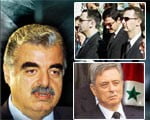
U.S. Secretary of State George Shultz and Syrian Foreign Minister Abdul Halim Khaddam in Damascus in 1983. (Khaddam became Vice President in 1984.)
Khaddam: What will become of Saad Haddad and his group (the commander of a Lebanese faction allied with Israel)?
Shultz: He will not be commander of a brigade or of the region.
Khaddam: What will he be?
Shultz: That is something the Lebanese will decide.
Farouk al-Sharaa (Syrian Foreign Minister): Under this agreement, will any Lebanese citizen be able to travel freely to the southernmost point of the country?
Shultz: Lebanese citizens will face no restrictions, apart from security procedures in certain areas.
al-Sharaa: Where does the security zone extend?
Philip Habib: From the international border to the Awali River, following its course, and then across the terrain south of the summit of Barouk, along the Barouk slopes, including the Ain passage, descending into the Bekaa.
Khaddam: How far into the Bekaa?
Shultz: To the end of Lebanese territory… all the way to the Syrian border.
Khaddam: But the Syrian-Lebanese border has not yet been demarcated…
Habib: You can resolve that quickly with the Lebanese.
Khaddam: What does the agreement say about Syria?
Shultz: Not a word… The Lebanese do not want to negotiate on Syria’s behalf.
Khaddam: One more question… and I apologize for the many questions… Suppose the Lebanese did not agree to the agreement. What would happen to it?
Shultz: I believe it would be… and this is merely my own speculation… that Israel would redeploy its forces in Lebanon and try to make its occupation of Lebanon permanent.
al-Sharaa: Clearly, there are security arrangements in Israel’s favor in the south. What, in return, are the security arrangements in Lebanon’s favor?
Shultz: Lebanon is building up its strength so that it can exercise control over all its territory. We are helping Lebanon, training its military forces, and equipping them. Everything I have heard suggests that the Lebanese have made fairly good progress in this regard. Therefore, the prospect of Lebanon fully regaining its sovereignty has popular support. As part of the general commitments contained in the agreement, each side undertakes not to carry out hostile acts against the other. Thus, there are assurances, for example, from Lebanon concerning what it might do against Israel, and vice versa. So there is a kind of broad set of reciprocal commitments contained in this agreement.
Khaddam: There has been a special relationship between Lebanon and Syria for several decades. Lebanon and Syria were once a single state. If we go back to Mr. Philip Habib’s records, we would find in the U.S. immigration records the name of Mr. Philip Habib’s father, listed as having come from Syria.
Habib: My father disagrees… He says from Turkey.
Khaddam: The Lebanese government was not free to negotiate… This is what the Lebanese Foreign Minister told us. He spoke at length about Israeli pressure, Israeli arrogance, and Israeli threats. On one occasion, as he told us, Tamer, a member of the Israeli delegation, requested a particular matter, and the Lebanese side rejected it. Tamer told the Lebanese: “If you do not accept tonight, 300 Druze could be killed, and tomorrow 10,000 Christians could be killed.” These are the words of Lebanon’s Foreign Minister and Brigadier Abbas Hamdan, a member of the negotiating delegation. We did not make this up… We heard it from Dr. Elie Salem, and you can ask him. Even President Amin Gemayel was threatened. Sharon visited Sheikh Pierre Gemayel, the father of the President of the Republic, and what did he tell him? He said: “You had two sons, and now you have one son… Either you accept, or your son will not remain President of the Republic.” This was also conveyed to us by members of the political bureau of the Kataeb Party. President Amin Gemayel… what could he have done, and would he have dared to do anything? Absolutely not. Is Saad Haddad an asset to the Lebanese?
AFP
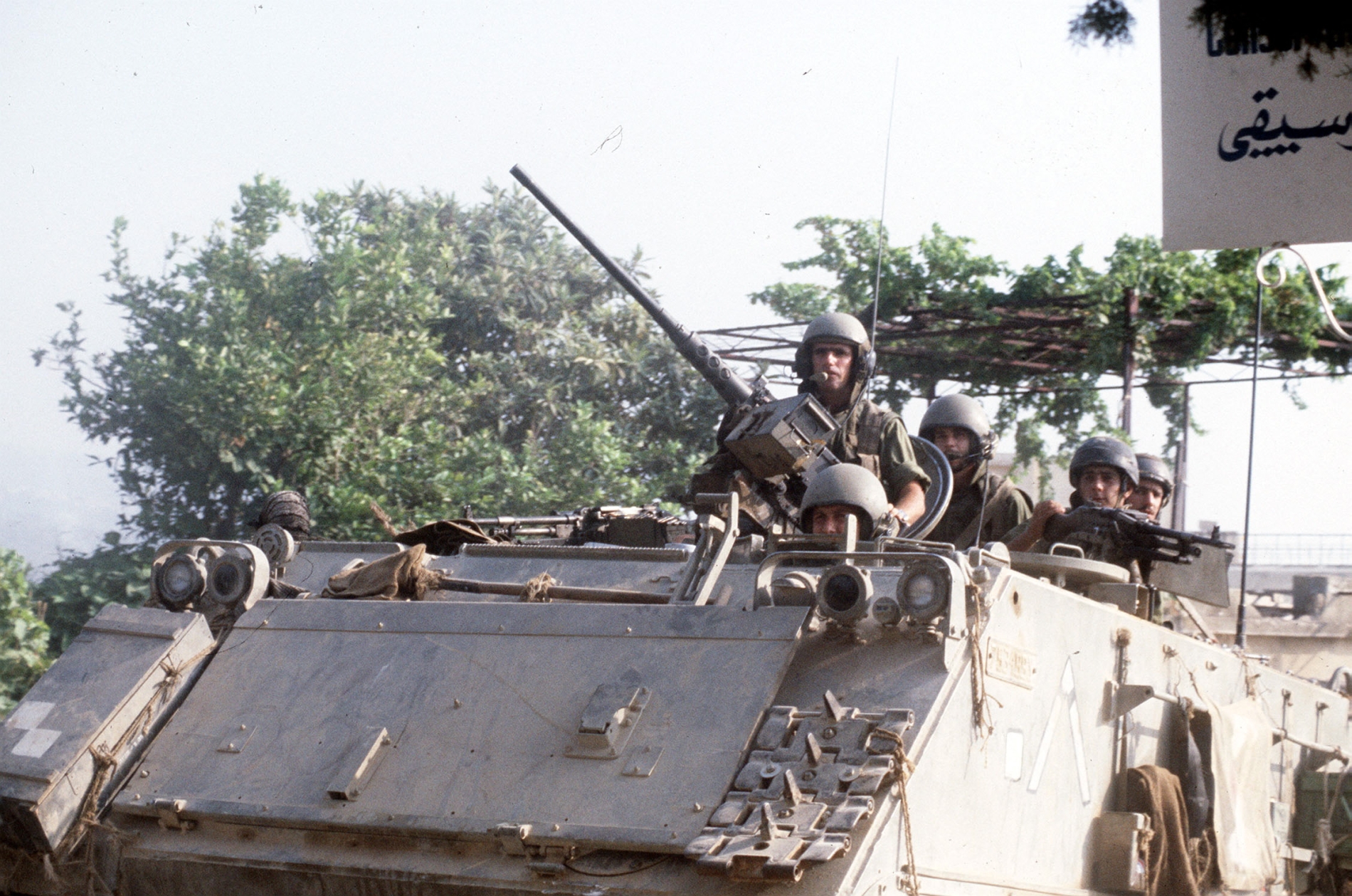
The Israeli army in Beirut during the 1982 Israeli invasion of Lebanon.
Shultz: One of the Israelis’ demands was that Saad Haddad be either the commander of southern Lebanon or of the security zone, or the commander of the brigade.
Khaddam: We agree to a three-way Syrian-Palestinian-Israeli withdrawal from Lebanon, without conditions, and for this agreement to be put to a popular referendum in Lebanon. In that case, we would accept whatever the Lebanese people decide. But the situation in Lebanon is different now. Terror is being practiced by the Kataeb forces. Every day there are killings and destruction…
Khaddam spoke about what Shultz had said regarding the need for the Syrian leadership to notify the U.S. military leadership if it wished to fly its aircraft over Lebanese or Syrian airspace adjacent to the border area. The Syrian minister said: “Under international law, I am in my own country and over my own territory, and I cannot fly unless I notify another country?” Philip Habib replied that this procedure was merely a practical measure to avoid accidents, nothing more. Khaddam ended the discussion by saying: “We said that when Israel withdraws, we will withdraw from Lebanon, but in our view, under this agreement, Israel will not withdraw.”
After the “May 17 Agreement” was officially announced, Shultz returned to Damascus on July 6, 1983, and met with Khaddam again. The latter vented his anger at the agreement, saying it was rejected by a broad segment of Lebanese Christians, such as National Bloc leader Raymond Eddé and former President Suleiman Frangieh, in addition, of course, to the categorical rejection by Walid Jumblatt and Nabih Berri. “If we set the Kataeb militias aside, we would find that these two leaders [Jumblatt and Berri] are larger and stronger [than the Kataeb]. All the parties in Lebanon, except the Kataeb, are against the agreement. If the United States wants to protect the agreement, it should send 200,000 Marines instead of 200. The entire population is against the agreement.”
Secret American Visits to Syria
The “May 17 Agreement” deprived Lebanon of an air-defense system for three years, and Khaddam described it as a “treaty of submission and surrender.” Shultz met with Assad, who reaffirmed his minister’s position: “We affirm Syria’s rejection of the agreement and of any discussion or negotiations based on this agreement, or on considering it a legitimate agreement.”
Following mediation by an Arab leader with President Assad, Robert McFarlane, Deputy Director of the U.S. National Security Council staff, made a secret visit to Damascus on July 17, 1983. He met with Assad and urged the Syrian president to move beyond the agreement in order to establish “close relations” with the United States, both politically and economically. He said President Reagan believed that, before achieving such an improvement in relations, he had to address the Arab-Israeli conflict at its roots, calling for cooperation on this matter.
The Americans often promised a comprehensive peace conference for the region, and they had in fact arranged one that Syria did not attend during the presidency of Richard Nixon. Assad showed no interest in the Americans’ new proposal, viewing it as a political bribe intended to ensure Syria’s silence over the “May 17 Agreement,” paving the way for its complete withdrawal from Lebanon.
On August 6, 1983, McFarlane arrived in Damascus, this time on a public visit, after being appointed President Reagan’s special envoy to the Middle East, and particularly to Lebanon. Khaddam asked him: “What would be the position of the United States and Israel if the Lebanese government announced the annulment of this agreement?” The following exchange took place:
McFarlane: I do not expect the Lebanese government to do that.
Khaddam: We accept whatever the Lebanese people decide. In that case, you will see that the Lebanese president will not be able to obtain 5 percent of the Lebanese people’s votes, and you will also see that this treaty will not receive 5 percent of the Lebanese people’s votes.
The following day, the Syrian president received McFarlane and told him that Syrian forces were deployed deep inside Lebanese territory, less than 45 kilometers from the border, and were prepared to advance if a peace agreement with Israel were imposed. The American envoy replied: “Yesterday, the Israelis reiterated their readiness to leave Lebanon within eight to twelve weeks, provided that all foreign forces leave Lebanon.” Khaddam told him: “We agree, provided that the agreement is annulled.”
The Syrian position was interpreted as a dual threat to both the Americans and the Israelis. On August 23, U.S. Ambassador Robert Paganelli in Damascus protested reports attributed to Syrian Defense Minister Mustafa Tlass that he would shell Beirut and the airport if the agreement continued. Khaddam denied that the Syrian defense minister had made such a statement. On the 28th of the same month, he received the American envoy Fairbanks, who came to complain about the heavy fire directed at U.S. forces in Lebanon by militias affiliated with the Syrian army in the south, as well as artillery salvos that struck the area near the U.S. ambassador’s residence. He said: “We want Syria to know that the United States intends to defend its personnel against attacks from any side, and it certainly will not stand by or remain passive when our personnel or facilities come under fire.”